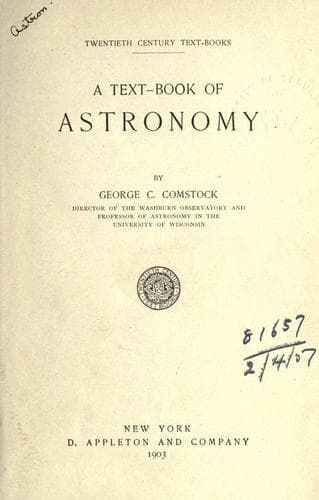
A Text-Book of AstronomyComstock, George C. (George Cary)
Science
A Text-Book of Astronomy
Comstock, George C. (George Cary)
Astronomy
The building of a good clock is equally important and has cost a like
amount of labor and pains, so that it is a far cry from Galileo and his
discovery that a pendulum "keeps time" to the modern clock with its
accurate construction and elaborate provision against disturbing
influences of every kind. Every such timepiece, whether it be of the
nutmeg variety which sells for a dollar, or whether it be the standard
clock of a great national observatory, is made up of the same essential
parts that fall naturally into four classes, which we may compare with
the departments of a well-ordered factory: I. A timekeeping department,
the pendulum or balance spring, whose oscillations must all be of equal
duration. II. A power department, the weights or mainspring, which,
when wound, store up the power applied from outside and give it out
piecemeal as required to keep the first department running. III. A
publication department, the dial and hands, which give out the time
furnished by Department I. IV. A transportation department, the wheels,
which connect the other three and serve as a means of transmitting power
and time from one to the other. The case of either clock or watch is
merely the roof which shelters it and forms no department of its
industry. Of these departments the first is by far the most important,
and its good or bad performance makes or mars the credit of the clock.
Beware of meddling with the balance wheel of your watch.
75. RADIANT ENERGY.--But we have now to consider other instruments which
in practice supplement or displace the simple apparatus hitherto
employed. Among the most important of these modern instruments are the
telescope, the spectroscope, and the photographic camera; and since all
these instruments deal with the light which comes from the stars to the
earth, we must for their proper understanding take account of the nature
of that light, or, more strictly speaking, we must take account of the
radiant energy emitted by the sun and stars, which energy, coming from
the sun, is translated by our nerves into the two different sensations
of light and heat. The radiant energy which comes from the stars is not
fundamentally different from that of the sun, but the amount of energy
furnished by any star is so small that it is unable to produce through
our nerves any sensible perception of heat, and for the same reason the
vast majority of stars are invisible to the unaided eye; they do not
furnish a sufficient amount of energy to affect the optic nerves. A hot
brick taken into the hand reveals its presence by the two different
sensations of heat and pressure (weight); but as there is only one brick
to produce the two sensations, so there is only one energy to produce
through its action upon different nerves the two sensations of light
and heat, and this energy is called _radiant_ because it appears to
stream forth radially from everything which has the capacity of emitting
it.
Public-domain text, read in full here on John Shaqi.
Reviews
Reviews
No reviews yet
Be the first to share your thoughts on this work.
Elsewhere in the archive
Join the Discussion
Join the discussion
Sign in to leave a comment or review.
Sign InorCreate an account