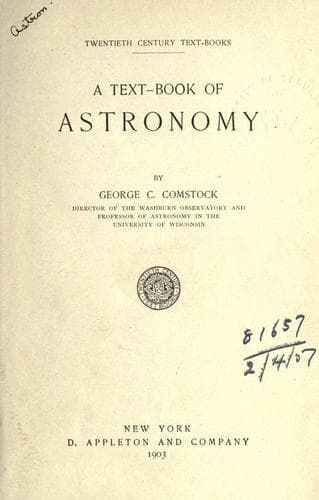
A Text-Book of AstronomyComstock, George C. (George Cary)
Science
A Text-Book of Astronomy
Comstock, George C. (George Cary)
Astronomy
For the detailed study of radiant energy the student is referred to
that branch of science called physics; but some of its elementary
principles may be learned through the following simple experiment, which
the student should not fail to perform for himself:
Drop a bullet or other similar object into a bucket of water and observe
the circular waves which spread from the place where it enters the
water. These waves are a form of radiant energy, but differing from
light or heat in that they are visibly confined to a single plane, the
surface of the water, instead of filling the entire surrounding space.
By varying the size of the bucket, the depth of the water, the weight of
the bullet, etc., different kinds of waves, big and little, may be
produced; but every such set of waves may be described and defined in
all its principal characteristics by means of three numbers--viz., the
vertical height of the waves from hollow to crest; the distance of one
wave from the next; and the velocity with which the waves travel across
the water. The last of these quantities is called the velocity of
propagation; the second is called the wave length; one half of the first
is called the amplitude; and all these terms find important applications
in the theory of light and heat.
The energy of the falling bullet, the disturbance which it produced on
entering the water, was carried by the waves from the center to the edge
of the bucket but not beyond, for the wave can go only so far as the
water extends. The transfer of energy in this way requires a perfectly
continuous medium through which the waves may travel, and the whole
visible universe is supposed to be filled with something called _ether_,
which serves everywhere as a medium for the transmission of radiant
energy just as the water in the experiment served as a medium for
transmitting in waves the energy furnished to it by the falling bullet.
The student may think of this energy as being transmitted in spherical
waves through the ether, every glowing body, such as a star, a candle
flame, an arc lamp, a hot coal, etc., being the origin and center of
such systems of waves, and determining by its own physical and chemical
properties the wave length and amplitude of the wave systems given off.
The intensity of any light depends upon the amplitude of the
corresponding vibration, and its color depends upon the wave length. By
ingenious devices which need not be here described it has been found
possible to measure the wave length corresponding to different
colors--e. g., all of the colors of the rainbow, and some of these wave
lengths expressed in tenth meters are as follows: A tenth meter is the
length obtained by dividing a meter into 10^{10} equal parts. 10^{10} =
10,000,000,000.
Color. Wave length.
Public-domain text, read in full here on John Shaqi.
Reviews
Reviews
No reviews yet
Be the first to share your thoughts on this work.
Elsewhere in the archive
Join the Discussion
Join the discussion
Sign in to leave a comment or review.
Sign InorCreate an account