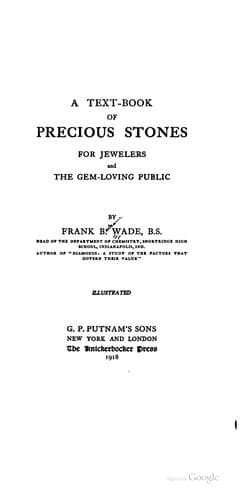
A Text-Book of Precious Stones for Jewelers and the Gem-Loving Public — John Shaqi
A Text-Book of Precious Stones for Jewelers and the Gem-Loving PublicWade, Frank Bertram
Science
A Text-Book of Precious Stones for Jewelers and the Gem-Loving Public
Wade, Frank Bertram
Precious stones
Let us begin with the beginning color of the visible spectrum, red, and
consider how a close study of shades of red can help in distinguishing
the various red stones from each other. In the first place we will
inquire what mineral species are likely to furnish us with red stones.
Omitting a number of rare minerals, we have (1) corundum ruby, (2)
garnet of various types, (3) zircon, (4) spinel, (5) tourmaline. These
five minerals are about the only common species which give us an
out-and-out red stone. Let us now consider the distinctions between the
reds of these different species. The red of the ruby, whether dark (Siam
type), blood red (Burmah type), or pale (Ceylon), is more pleasing
usually than the red of any of the other species. Viewed from the back
of the stone (by transmitted light) it is still pleasing. It may be
purplish, but is seldom orange red. Also, owing to the dichroism of the
ruby the red is variable according to the changing position of the
stone. It therefore has a certain life and variety not seen in any of
the others except perhaps in red tourmaline, which, however, does not
approach ruby in fineness of red color.
RED STONES OF SIMILAR SHADES. The garnet, on the other hand, when of
fire-red hue, is darker than any but the Siam ruby. It is also more
inclined to orange red or brownish red--and the latter is especially
true when the stone is seen against the light (by transmitted light).
Its color then resembles that of a solution of "iron" such as is given
as medicine. The so-called "almandine" garnets (those of purplish-red
tint) do not equal the true ruby in brightness of color and when held up
to the light show more prismatic colors than the true ruby, owing to the
greater dispersion of garnet. The color also lacks variety (owing to
lack of dichroism). While a fine garnet may make a fair-looking "ruby"
when by itself, it looks inferior and dark when beside a fine ruby. By
artificial light, too, the garnet is dark as compared with the true
ruby, and the latter shows its color at a distance much more strongly
than the garnet.
The red zircon, or true hyacinth, is rare. (Many hessonite garnets are
sold as hyacinths in the trade. These are usually of a brownish red.)
The red of the hyacinth is never equal to that of the ruby. It is
usually more somber, and a bit inclined to a brownish cast. The
dispersion of zircon, too, is so large (about 87 per cent. of that of
diamond) that some little "color-play" is likely to appear along with
the intrinsic color. The luster too is almost adamantine while that of
ruby is softer and vitreous. Although strongly doubly refracting, the
hyacinth shows scarcely any dichroism and thus lacks variety of color.
Hence a trained eye will at once note these differences and not confound
the stone with ruby.
Public-domain text, read in full here on John Shaqi.
Reviews
Reviews
No reviews yet
Be the first to share your thoughts on this work.
Join the Discussion
Join the discussion
Sign in to leave a comment or review.
Sign InorCreate an account