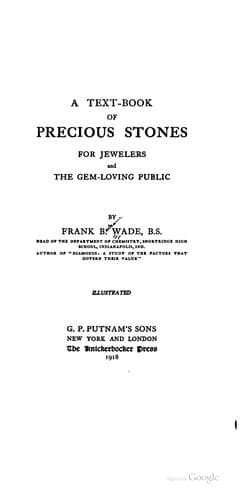
A Text-Book of Precious Stones for Jewelers and the Gem-Loving PublicWade, Frank Bertram
Science
A Text-Book of Precious Stones for Jewelers and the Gem-Loving Public
Wade, Frank Bertram
Precious stones
PERIDOT AND OLIVINE. The mineral "_olivine_" gives us the "_peridot_"
(this name should be kept for the deeper bottle green stones), and the
olive green gems of this same mineral may correctly be called
"_olivine_" or "_chrysolite_." As was explained under garnet, jewelers
frequently use the term "olivine" to designate demantoid garnet. The
term chrysolite is also sometimes incorrectly used for the
greenish-yellow chrysoberyl.
FELDSPAR GEMS. Among the minerals softer than quartz, which are used as
gems, we have also "_feldspar_," which gives us "_moonstone_,"
"_Labradorite_," and "_Amazonite_."
An opalescent form of chalcedony is frequently gathered on California
beaches and polished for tourists under the name of "_California
Moonstone_." This name is unfortunately chosen as the material is not
the same as that of true moonstone and the effect is not so pronounced
or so beautiful. The polished stones show merely a milky cloudiness
without any of that beautiful sheen of the true moonstone.
"_Labradorite_" is usually correctly named. "_Amazonite_" was originally
misnamed, as none is found along the river of that name. The term has
come into such general use, however, that we shall probably have to
continue to use it, especially as no other name has come into use for
this bluish-green feldspar. As has already been said, amazonite is
sometimes sold as "jade," which is incorrect.
MALACHITE, AZURITE, AND LAPIS LAZULI. _Malachite_ and _azurite_ are
usually correctly named, but "_lapis lazuli_" is a name that is
frequently misused, being applied to crackled quartz that has been
stained with Prussian blue, or some other dye, to an unconvincing
resemblance to true lapis. Such artificially produced stones are
sometimes sold as "_Swiss lapis_." They are harder than true lapis and
probably wear much better in exposed ornaments, but they are not lapis
and are never of equal color, and names should not be misused, and
especially is this true in a trade where the public has had to rely so
completely upon the knowledge and the integrity of the dealer.
With the increase of knowledge about precious stones that is slowly but
steadily growing among the public, it becomes more than ever necessary
for the jeweler and gem dealer to know and to use the correct names for
all precious stones. The student who wishes to learn more about the
matter will have to cull his information from many different works on
gems. G. F. Herbert-Smith, in his _Gem-Stones_, gives a three and one
half page chapter on "Nomenclature of Precious Stones" (Chap. XIII., pp.
109-112). The present lesson has attempted to bring together in one
place material from many sources, together with some suggestions from
the author.
LESSON XXI
WHERE PRECIOUS STONES ARE FOUND
Public-domain text, read in full here on John Shaqi.
Reviews
Reviews
No reviews yet
Be the first to share your thoughts on this work.
Elsewhere in the archive
Join the Discussion
Join the discussion
Sign in to leave a comment or review.
Sign InorCreate an account