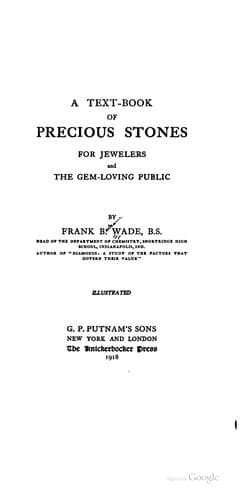
A Text-Book of Precious Stones for Jewelers and the Gem-Loving PublicWade, Frank Bertram
Science
A Text-Book of Precious Stones for Jewelers and the Gem-Loving Public
Wade, Frank Bertram
Precious stones
OCCURRENCE OF DIAMOND. Every dealer in precious stones should know
something of the sources of the gems that he sells. The manner of the
occurrence of the rough material is also a matter of interest. It will
therefore be the purpose of this lesson to give a brief account of the
geographical sources of the principal gems and of their mode of
occurrence in the earth.
For the sake of uniformity of treatment we will once more follow the
descending order of hardness among the gems and we thus begin by
describing the occurrence of diamond. It will be of interest to note
first that the earliest source of the diamond was India, and that for
many years India was almost the sole source. Tavernier tells us that the
diamond mining industry was in a thriving state during the years from
1640 to 1680, during which time he made six journeys to India to
purchase gems. He speaks of Borneo as another source of diamonds, but
most of the diamonds of that time were furnished by India.
"GOLCONDAS." Indian diamonds were noteworthy for their magnificent
steely blue-white quality and their great hardness, and occasionally one
comes on the market to-day with an authentic pedigree, tracing its
origin back to the old Indian mines, and such stones usually command
very high prices. One of a little over seven and one half carats in
weight, in the form of a perfect drop brilliant, has lately been offered
for sale at a price not far from $1,000 per carat. Such diamonds are
sometimes called "Golcondas" because one of the mining districts from
which the fine large Indian stones came was near the place of that name.
Some of the stones from the Jägersfontein mine in South Africa resemble
the Golcondas in quality. Many of the large historical crown diamonds
of Europe came from the Indian mines.
The stones were found in a sedimentary material, a sort of conglomerate,
in which they, together with many other crystalline materials, had
become imprisoned. Their original source has never been determined. They
are therefore of the so-called "River" type of stone, having probably
been transported from their original matrix, after the disintegration of
the latter, to new places of deposit, by the carrying power of river
waters.
The Indian mines now yield very few stones. The United States Consular
reports occasionally mention the finding of a few scattered crystals but
the rich deposits were apparently worked out during the seventeenth
century and the early part of the eighteenth century.
In 1725 and in the few following years the Brazilian diamond fields
began to supersede those of India. Like the latter, the Brazilian fields
were alluvial, that is, the materials were deposited by river action
after having been carried to some distance from their original sources.
Public-domain text, read in full here on John Shaqi.
Reviews
Reviews
No reviews yet
Be the first to share your thoughts on this work.
Elsewhere in the archive
Join the Discussion
Join the discussion
Sign in to leave a comment or review.
Sign InorCreate an account