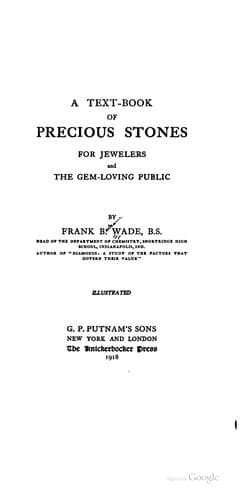
A Text-Book of Precious Stones for Jewelers and the Gem-Loving PublicWade, Frank Bertram
Science
A Text-Book of Precious Stones for Jewelers and the Gem-Loving Public
Wade, Frank Bertram
Precious stones
ORIENT. The fineness of the luster of a pearl, or as is said in the
trade, the _orient_, depends upon the number of layers that take part in
the reflection, and this number in turn depends upon the translucency of
the material and the thinness of the layers. Very fine pearls usually
have very many, very thin layers taking part in the reflection. The
degree of translucency, considered apart, is sometimes called the
"water" of the pearl.
In addition to their beautiful luster, many pearls display iridescence,
and this is due in part, as in the case of the pearly lining of the
shell (mother of pearl) to overlapping of successive layers, like the
overlapping of shingles on a roof. This gives rise to a lined surface,
much like the diffraction grating of the physicist, which is made by
ruling a glass plate with thousands of parallel lines to the inch. Such
a grating produces wonderful spectra, in which the rainbow colors are
widely separated and very vivid. The principal on which this separation
of light depends is known as diffraction and cannot be explained here,
but a similar effect takes place when light falls on the naturally ruled
surface of a pearl and helps produce the play of colors known as
iridescence. The thin layers themselves also help to produce the
iridescence by interference of light much as in the case of the opal,
which has already been discussed.
COLOR. Having explained the cause of the orient and water of pearls, the
_color_ must next be considered. Pearls may be had of almost any color,
but the majority of fine pearls are white, or nearly so. The fine
Oriental pearls frequently have a creamy tint. Among fresh water pearls
the creamy tint is less often seen, but fine pink tints occur.
Occasionally a black pearl is found and on account of its rarity
commands a price nearly as great as that obtainable for a white pearl of
similar size and quality.
The value of pearls depends upon several different factors and it is far
from an easy matter to estimate the value of a fine specimen. It is much
easier to grade and estimate the value of diamonds than to do the same
for pearls, and it is only by long and intimate acquaintance with the
pearls themselves that one can hope to become expert in deciding values.
There are, however, several general factors that govern the value of
pearls. Chief among these are: 1, _Orient_; 2, _Color_; 3, _Texture or
Skin_; 4, _Shape and Size_.
FACTORS GOVERNING THE VALUE OF PEARLS. Taking up each of these factors
in turn, it may be said of the first that unless a pearl has that fine
keen luster known as a fine orient, it is of but limited value. No
matter what the size, or how perfect the shape, it is nothing, if dead
and lusterless. To have great value the gem must gleam with that soft
but lively luster peculiar to fine specimens of pearl. With variations
in orient go wide variations in value.
Public-domain text, read in full here on John Shaqi.
Reviews
Reviews
No reviews yet
Be the first to share your thoughts on this work.
Elsewhere in the archive
Join the Discussion
Join the discussion
Sign in to leave a comment or review.
Sign InorCreate an account