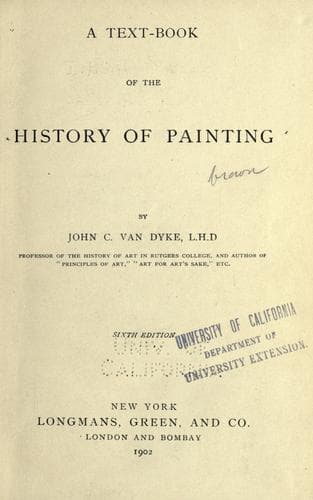
A Text-Book of the History of PaintingVan Dyke, John C.
History
A Text-Book of the History of Painting
Van Dyke, John C.
Painting -- History
PRINCIPAL WORKS: All the painters mentioned in this chapter
are best represented in the Louvre at Paris, at Versailles,
and in the museums of the chief French cities. Some works of
the late or living men may be found in the Luxembourg, where
pictures bought by the state are kept for ten years after
the painter's death, and then are either sent to the Louvre
or to the other municipal galleries of France. Some pictures
by these men are also to be seen in the Metropolitan Museum,
New York, the Boston Museum, and the Chicago Art Institute.
CHAPTER XIV.
FRENCH PAINTING.
THE NINETEENTH CENTURY (_Continued_).
BOOKS RECOMMENDED: The books before mentioned, consult also
General Bibliography, (page xv.)
THE LANDSCAPE PAINTERS: The influence of either the classic or
romantic example may be traced in almost all of the French painting of
this century. The opposed teachings find representatives in new men,
and under different names the modified dispute goes on--the dispute of
the academic _versus_ the individual, the art of form and line
_versus_ the art of sentiment and color.
With the classicism of David not only the figure but the landscape
setting of it, took on an ideal heroic character. Trees and hills and
rivers became supernaturally grand and impressive. Everything was
elevated by method to produce an imaginary Arcadia fit for the deities
of the classic world. The result was that nature and the humanity of
the painter passed out in favor of school formula and academic
traditions. When romanticism came in this was changed, but nature
falsified in another direction. Landscape was given an interest in
human affairs, and made to look gay or sad, peaceful or turbulent, as
the day went well or ill with the hero of the story portrayed. It was,
however, truer to the actual than the classic, more studied in the
parts, more united in the whole. About the year 1830 the influence of
romanticism began to show in a new landscape art. That is to say, the
emotional impulse springing from romanticism combined with the study
of the old Dutch landscapists, and the English contemporary painters,
Constable and Bonington, set a large number of painters to the close
study of nature and ultimately developed what has been vaguely called
the
FONTAINEBLEAU-BARBIZON SCHOOL: This whole school was primarily devoted
to showing the sentiment of color and light. It took nature just as it
found it in the forest of Fontainebleau, on the plain of Barbizon, and
elsewhere, and treated it with a poetic feeling for light, shadow,
atmosphere, color, that resulted in the best landscape painting yet
known to us.
[Illustration: FIG. 64.--COROT. LANDSCAPE.]
Public-domain text, read in full here on John Shaqi.
Reviews
Reviews
No reviews yet
Be the first to share your thoughts on this work.
Elsewhere in the archive
Join the Discussion
Join the discussion
Sign in to leave a comment or review.
Sign InorCreate an account