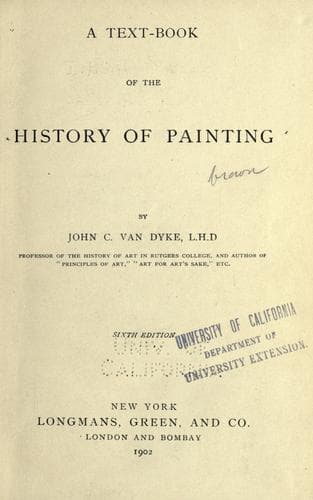
A Text-Book of the History of PaintingVan Dyke, John C.
History
A Text-Book of the History of Painting
Van Dyke, John C.
Painting -- History
Corot (1796-1875) though classically trained under Bertin, and though
somewhat apart from the other men in his life, belongs with this
group. He was a man whose artistic life was filled with the beauty of
light and air. These he painted with great singleness of aim and great
poetic charm. Most of his work is in a light silvery key of color,
usually slight in composition, simple in masses of light and dark,
and very broadly but knowingly handled with the brush. He began
painting by using the minute brush, but changed it later on for a
freer style which recorded only the great omnipresent truths and
suppressed the small ones. He has never had a superior in producing
the permeating light of morning and evening. For this alone, if for no
other excellence, he deservedly holds high rank.
Rousseau (1812-1867) was one of the foremost of the recognized
leaders, and probably the most learned landscapist of this century. A
man of many moods and methods he produced in variety with rare
versatility. Much of his work was experimental, but at his best he had
a majestic conception of nature, a sense of its power and permanence,
its volume and mass, that often resulted in the highest quality of
pictorial poetry. In color he was rich and usually warm, in technic
firm and individual, in sentiment at times quite sublime. At first he
painted broadly and won friends among the artists and sneers from the
public; then in his middle style he painted in detail, and had a
period of popular success; in his late style he went back to the broad
manner, and died amid quarrels and vexations of spirits. His long-time
friend and companion, Jules Dupre (1812-1889), hardly reached up to
him, though a strong painter in landscape and marine. He was a good
but not great colorist, and, technically, his brush was broad enough
but sometimes heavy. His late work is inferior in sentiment and
labored in handling. Diaz (1808-1876) was allied to Rousseau in aim
and method, though not so sure nor so powerful a painter. He had fancy
and variety in creation that sometimes ran to license, and in color he
was clear and brilliant. Never very well trained, his drawing is often
indifferent and his light distorted, but these are more than atoned
for by delicacy and poetic charm. At times he painted with much power.
Daubigny (1817-1878) seemed more like Corot in his charm of style and
love of atmosphere and light than any of the others. He was fond of
the banks of the Seine and the Marne at twilight, with evening
atmospheres and dark trees standing in silent ranks against the warm
sky. He was also fond of the gray day along the coast, and even the
sea attracted him not a little. He was a painter of high abilities,
and in treatment strongly individual, even distinguished, by his
simplicity and directness. Unity of the whole, grasp of the mass
entire, was his technical aim, and this he sought to get not so much
by line as by color-tones of varying value. In this respect he seemed
Public-domain text, read in full here on John Shaqi.
Reviews
Reviews
No reviews yet
Be the first to share your thoughts on this work.
Elsewhere in the archive
Join the Discussion
Join the discussion
Sign in to leave a comment or review.
Sign InorCreate an account