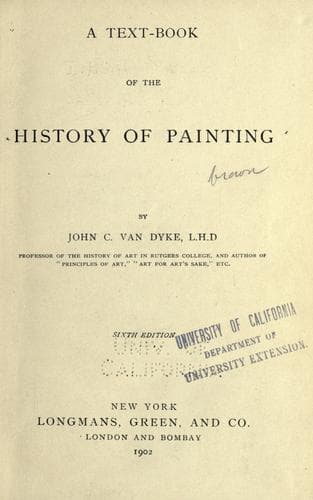
A Text-Book of the History of PaintingVan Dyke, John C.
History
A Text-Book of the History of Painting
Van Dyke, John C.
Painting -- History
THE SEMI-CLASSICISTS: It must not be inferred that the classic
influence of David and Ingres disappeared from view with the coming of
the romanticists, the Fontainebleau landscapists, and the Barbizon
painters. On the contrary, side by side with these men, and opposed
to them, were the believers in line and academic formulas of the
beautiful. The whole tendency of academic art in France was against
Delacroix, Rousseau, and Millet. During their lives they were regarded
as heretics in art and without the pale of the Academy. Their art,
however, combined with nature study and the realism of Courbet,
succeeded in modifying the severe classicism of Ingres into what has
been called semi-classicism. It consists in the elevated, heroic, or
historical theme, academic form well drawn, some show of bright
colors, smoothness of brush-work, and precision and nicety of detail.
In treatment it attempts the realistic, but in spirit it is usually
stilted, cold, unsympathetic.
Cabanel (1823-1889) and Bouguereau (1825-1905) have both represented
semi-classic art well. They are justly ranked as famous draughtsmen
and good portrait-painters, but their work always has about it the
stamp of the academy machine, a something done to order, knowing and
exact, but lacking in the personal element. It is a weakness of the
academic method that it virtually banishes the individuality of eye
and hand in favor of school formulas. Cabanel and Bouguereau have
painted many incidents of classic and historic story, but with never a
dash of enthusiasm or a suggestion of the great qualities of painting.
Their drawing has been as thorough as could be asked for, but their
colorings have been harsh and their brushes cold and thin.
Gerome (1824-[12]) is a man of classic training and inclination, but
his versatility hardly allows him to be classified anywhere. He was
first a leader of the New-Greeks, painting delicate mythological
subjects; then a historical painter, showing deaths of Caesar and the
like; then an Orientalist, giving scenes from Cairo and
Constantinople; then a _genre_ painter, depicting contemporary
subjects in the many lands through which he has travelled. Whatever he
has done shows semi-classic drawing, ethnological and archaeological
knowledge, Parisian technic, and exact detail. His travels have not
changed his precise scientific point of view. He is a true academician
at bottom, but a more versatile and cultured painter than either
Cabanel or Bouguereau. He draws well, sometimes uses color well, and
is an excellent painter of textures. A man of great learning in many
departments he is no painter to be sneered at, and yet not a painter
to make the pulse beat faster or to arouse the aesthetic emotions. His
work is impersonal, objective fact, showing a brilliant exterior but
inwardly devoid of feeling.
[Footnote 12: Died, 1904.]
[Illustration: FIG. 66.--MILLET. THE GLEANERS. LOUVRE.]
Public-domain text, read in full here on John Shaqi.
Reviews
Reviews
No reviews yet
Be the first to share your thoughts on this work.
Elsewhere in the archive
Join the Discussion
Join the discussion
Sign in to leave a comment or review.
Sign InorCreate an account