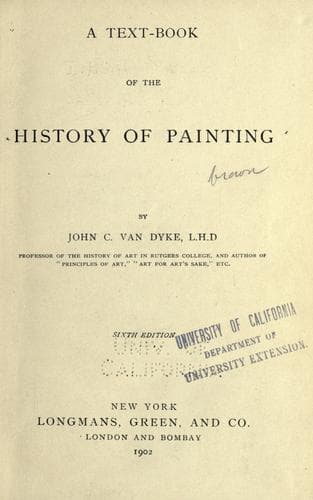
A Text-Book of the History of PaintingVan Dyke, John C.
History
A Text-Book of the History of Painting
Van Dyke, John C.
Painting -- History
Paul Baudry (1828-1886), though a disciple of line, was not precisely
a semi-classicist, and perhaps for that reason was superior to any of
the academic painters of his time. He was a follower of the old
masters in Rome more than the _Ecole des Beaux Arts_. His subjects,
aside from many splendid portraits, were almost all classical,
allegorical, or mythological. He was a fine draughtsman, and, what is
more remarkable in conjunction therewith, a fine colorist. He was
hardly a great originator, and had not passion, dramatic force, or
much sentiment, except such as may be found in his delicate coloring
and rhythm of line. Nevertheless he was an artist to be admired for
his purity of purpose and breadth of accomplishment. His chief work is
to be seen in the Opera at Paris. Puvis de Chavannes (1824-[13]) is
quite a different style of painter, and is remarkable for fine
delicate tones of color which hold their place well on wall or
ceiling, and for a certain grandeur of composition. In his desire to
revive the monumental painting of the Renaissance he has met with much
praise and much blame. He is an artist of sincerity and learning, and
as a wall-painter has no superior in contemporary France.
[Footnote 13: Died, 1898.]
Hebert (1817-1908), an early painter of academic tendencies, and
Henner (1829-), fond of form and yet a brushman with an idyllic
feeling for light and color in dark surroundings, are painters who may
come under the semi-classic grouping. Lefebvre (1834-) is probably the
most pronounced in academic methods among the present men, a
draughtsman of ability.
Public-domain text, read in full here on John Shaqi.
Reviews
Reviews
No reviews yet
Be the first to share your thoughts on this work.
Elsewhere in the archive
Join the Discussion
Join the discussion
Sign in to leave a comment or review.
Sign InorCreate an account