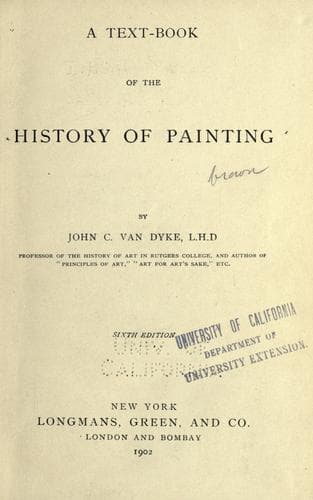
A Text-Book of the History of PaintingVan Dyke, John C.
History
A Text-Book of the History of Painting
Van Dyke, John C.
Painting -- History
THE REALISTS: About the time of the appearance of Millet, say 1848,
there also came to the front a man who scorned both classicism and
romanticism, and maintained that the only model and subject of art
should be nature. This man, Courbet (1819-1878), really gave a third
tendency to the art of this century in France, and his influence
undoubtedly had much to do with modifying both the classic and
romantic tendencies. Courbet was a man of arrogant, dogmatic
disposition, and was quite heartily detested during his life, but that
he was a painter of great ability few will deny. His theory was the
abolition of both sentiment and academic law, and the taking of nature
just as it was, with all its beauties and all its deformities. This,
too, was his practice to a certain extent. His art is material, and
yet at times lofty in conception even to the sublime. And while he
believed in realism he did not believe in petty detail, but rather in
the great truths of nature. These he saw with a discerning eye and
portrayed with a masterful brush. He believed in what he saw only, and
had more the observing than the reflective or emotional disposition.
As a technician he was coarse but superbly strong, handling sky,
earth, air, with the ease and power of one well trained in his craft.
His subjects were many--the peasantry of France, landscape, and the
sea holding prominent places--and his influence, though not direct
because he had no pupils of consequence, has been most potent with the
late men.
[Illustration: FIG. 67.--CABANEL. PHAEDRA.]
The young painter of to-day who does things in a "realistic" way is
frequently met with in French art. L'hermitte (1844-), Julien Dupre
(1851-), and others have handled the peasant subject with skill, after
the Millet-Courbet initiative; and Bastien-Lepage (1848-1884) excited
a good deal of admiration in his lifetime for the truth and evident
sincerity of his art. Bastien's point of view was realistic enough,
but somewhat material. He never handled the large composition with
success, but in small pieces and in portraits he was quite above
criticism. His following among the young men was considerable, and the
so-called impressionists have ranked him among their disciples or
leaders.
Public-domain text, read in full here on John Shaqi.
Reviews
Reviews
No reviews yet
Be the first to share your thoughts on this work.
Elsewhere in the archive
Join the Discussion
Join the discussion
Sign in to leave a comment or review.
Sign InorCreate an account