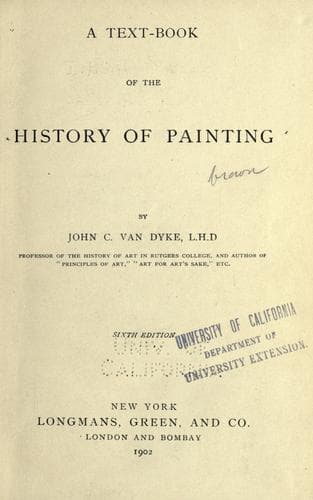
A Text-Book of the History of PaintingVan Dyke, John C.
History
A Text-Book of the History of Painting
Van Dyke, John C.
Painting -- History
PAINTERS OF MILITARY SCENES, GENRE, ETC.: The art of Meissonier
(1815-1891), while extremely realistic in modern detail, probably
originated from a study of the seventeenth-century Dutchmen like
Terburg and Metsu. It does not portray low life, but rather the
half-aristocratic--the scholar, the cavalier, the gentleman of
leisure. This is done on a small scale with microscopic nicety, and
really more in the historical than the _genre_ spirit. Single figures
and interiors were his preference, but he also painted a cycle of
Napoleonic battle-pictures with much force. There is little or no
sentiment about his work--little more than in that of Gerome. His
success lay in exact technical accomplishment. He drew well, painted
well, and at times was a superior colorist. His art is more admired by
the public than by the painters; but even the latter do not fail to
praise his skill of hand. He was a great craftsman in the infinitely
little. As a great artist his rank is still open to question.
The _genre_ painting of fashionable life has been carried out by many
followers of Meissonier, whose names need not be mentioned since they
have not improved upon their forerunner. Toulmouche (1829-), Leloir
(1843-1884), Vibert (1840-), Bargue (?-1883), and others, though
somewhat different from Meissonier, belong among those painters of
_genre_ who love detail, costumes, stories, and pretty faces. Among
the painters of military _genre_ mention should be made of De Neuville
(1836-1885), Berne-Bellecour (1838-), Detaille (1848-), and Aime-Morot
(1850-), all of them painters of merit.
Quite a different style of painting--half figure-piece half
_genre_--is to be found in the work of Ribot (1823-), a strong
painter, remarkable for his apposition of high flesh lights with deep
shadows, after the manner of Ribera, the Spanish painter. Roybet
(1840-) is fond of rich stuffs and tapestries with velvet-clad
characters in interiors, out of which he makes good color effects.
Bonvin (1817-1887) and Mettling have painted the interior with small
figures, copper-kettles, and other still-life that have given
brilliancy to their pictures. As a still-life painter Vollon (1833-)
has never had a superior. His fruits, flowers, armors, even his small
marines and harbor pieces, are painted with one of the surest brushes
of this century. He is called the "painter's painter," and is a man of
great force in handling color, and in large realistic effect. Dantan
and Friant have both produced canvases showing figures in interiors.
Public-domain text, read in full here on John Shaqi.
Reviews
Reviews
No reviews yet
Be the first to share your thoughts on this work.
Elsewhere in the archive
Join the Discussion
Join the discussion
Sign in to leave a comment or review.
Sign InorCreate an account