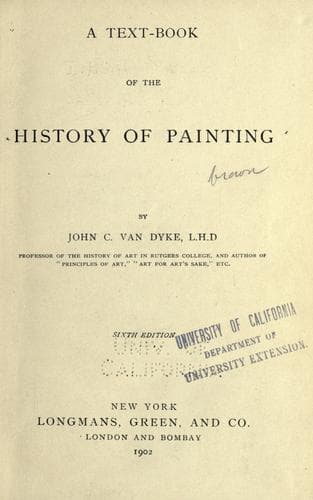
A Text-Book of the History of PaintingVan Dyke, John C.
History
A Text-Book of the History of Painting
Van Dyke, John C.
Painting -- History
METHODS OF PAINTING: Spanish art worthy of mention did not appear
until the fifteenth century. At that time Spain was in close relations
with the Netherlands, and Flemish painting was somewhat followed. How
much the methods of the Van Eycks influenced Spain would be hard to
determine, especially as these Northern methods were mixed with
influences coming from Italy. Finally, the Italian example prevailed
by reason of Spanish students in Italy and Italian painters in Spain.
Florentine line, Venetian color, and Neapolitan light-and-shade ruled
almost everywhere, and it was not until the time of Velasquez--the
period just before the eighteenth-century decline--that distinctly
Spanish methods, founded on nature, really came forcibly to the front.
SPANISH SCHOOLS OF PAINTING: There is difficulty in classifying these
schools of painting because our present knowledge of them is limited.
Isolated somewhat from the rest of Europe, the Spanish painters have
never been critically studied as the Italians have been, and what is
at present known about the schools must be accepted subject to
critical revision hereafter.
[Illustration: FIG. 70.--MURILLO. ST. ANTHONY OF PADUA. BERLIN.]
The earliest school seems to have been made up from a gathering of
artists at Toledo, who limned, carved, and gilded in the cathedral;
but this school was not of long duration. It was merged into the
Castilian school, which, after the building of Madrid, made its home
in that capital and drew its forces from the towns of Toledo,
Valladolid, and Badajoz. The Andalusian school, which rose about the
middle of the sixteenth century, was made up from the local schools of
Seville, Cordova, and Granada. The Valencian school, to the
southeast, rose about the same time, and was finally merged into the
Andalusian. The Aragonese school, to the east, was small and of no
great consequence, though existing in a feeble way to the end of the
seventeenth century. The painters of these schools are not very
strongly marked apart by methods or school traditions, and perhaps the
divisions would better be looked upon as more geographical than
otherwise. None of the schools really began before the sixteenth
century, though there are names of artists and some extant pictures
before that date, and with the seventeenth century all art in Spain
seems to have centred about Madrid.
Spanish painting started into life concurrently with the rise to
prominence of Spain as a political kingdom. What, if any, direct
effect the maritime discoveries, the conquests of Granada and Naples,
the growth of literature, and the decline of Italy, may have had upon
Spanish painting can only be conjectured; but certainly the sudden
advance of the nation politically and socially was paralleled by the
advance of its art.
Public-domain text, read in full here on John Shaqi.
Reviews
Reviews
No reviews yet
Be the first to share your thoughts on this work.
Elsewhere in the archive
Join the Discussion
Join the discussion
Sign in to leave a comment or review.
Sign InorCreate an account