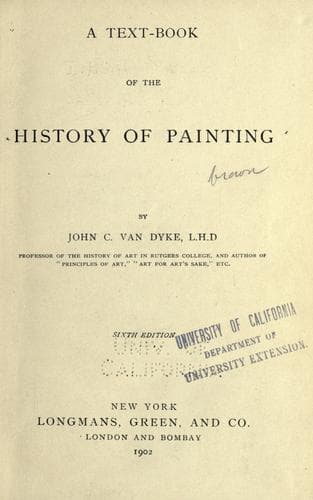
A Text-Book of the History of PaintingVan Dyke, John C.
History
A Text-Book of the History of Painting
Van Dyke, John C.
Painting -- History
SPANISH ART MOTIVES: What may have been the early art of Spain we are
at a loss to conjecture. The reigns of the Moor, the Iconoclast, and,
finally, the Inquisitor, have left little that dates before the
fourteenth century. The miniatures and sacred relics treasured in the
churches and said to be of the apostolic period, show the traces of a
much later date and a foreign origin. Even when we come down to the
fifteenth century and meet with art produced in Spain, we have a
following of Italy or the Netherlands. In methods and technic it was
derivative more than original, though almost from the beginning
peculiarly Spanish in spirit.
[Illustration: FIG. 69.--SANCHEZ COELLO. CLARA EUGENIA, DAUGHTER OF
PHILIP II. MADRID.]
That spirit was a dark and savage one, a something that cringed under
the lash of the Church, bowed before the Inquisition, and played the
executioner with the paint-brush. The bulk of Spanish art was Church
art, done under ecclesiastical domination, and done in form without
question or protest. The religious subject ruled. True enough, there
was portraiture of nobility, and under Philip and Velasquez a
half-monarchical art of military scenes and _genre_; but this was not
the bent of Spanish painting as a whole. Even in late days, when
Velasquez was reflecting the haughty court, Murillo was more widely
and nationally reflecting the believing provinces and the Church
faith of the people. It is safe to say, in a general way, that the
Church was responsible for Spanish art, and that religion was its
chief motive.
There was no revived antique, little of the nude or the pagan, little
of consequence in landscape, little, until Velasquez's time, of the
real and the actual. An ascetic view of life, faith, and the hereafter
prevailed. The pietistic, the fervent, and the devout were not so
conspicuous as the morose, the ghastly, and the horrible. The saints
and martyrs, the crucifixions and violent deaths, were eloquent of the
torture-chamber. It was more ecclesiasticism by blood and violence
than Christianity by peace and love. And Spain welcomed this. For of
all the children of the Church she was the most faithful to rule,
crushing out heresy with an iron hand, gaining strength from the
Catholic reaction, and upholding the Jesuits and the Inquisition.
Public-domain text, read in full here on John Shaqi.
Reviews
Reviews
No reviews yet
Be the first to share your thoughts on this work.
Elsewhere in the archive
Join the Discussion
Join the discussion
Sign in to leave a comment or review.
Sign InorCreate an account