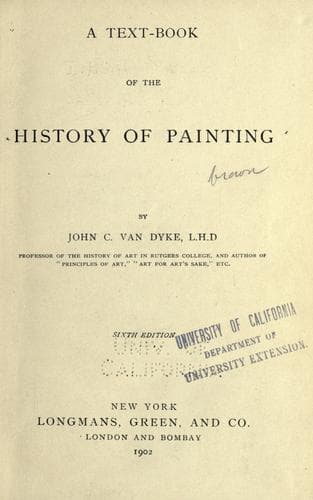
A Text-Book of the History of PaintingVan Dyke, John C.
History
A Text-Book of the History of Painting
Van Dyke, John C.
Painting -- History
Velasquez (1599-1660) is the greatest name in the history of Spanish
painting. With him Spanish art took upon itself a decidedly
naturalistic and national stamp. Before his time Italy had been freely
imitated; but though Velasquez himself was in Italy for quite a long
time, and intimately acquainted with great Italian art, he never
seemed to have been led away from his own individual way of seeing and
doing. He was a pupil of Herrera, afterward with Pacheco, and learned
much from Ribera and Tristan, but more from a direct study of nature
than from all the others. He was in a broad sense a realist--a man who
recorded the material and the actual without emendation or
transposition. He has never been surpassed in giving the solidity and
substance of form and the placing of objects in atmosphere. And this,
not in a small, finical way, but with a breadth of view and of
treatment which are to-day the despair of painters. There was nothing
of the ethereal, the spiritual, the pietistic, or the pathetic about
him. He never for a moment left the firm basis of reality. Standing
upon earth he recorded the truths of the earth, but in their largest,
fullest, most universal forms.
Technically his was a master-hand, doing all things with ease, giving
exact relations of colors and lights, and placing everything so
perfectly that no addition or alteration is thought of. With the brush
he was light, easy, sure. The surface looks as though touched once, no
more. It is the perfection of handling through its simplicity and
certainty, and has not the slightest trace of affectation or
mannerism. He was one of the few Spanish painters who were enabled to
shake off the yoke of the Church. Few of his canvases are religious in
subject. Under royal patronage he passed almost all of his life in
painting portraits of the royal family, ministers of state, and great
dignitaries. As a portrait-painter he is more widely known than as a
figure-painter. Nevertheless he did many canvases like The Tapestry
Weavers and The Surrender at Breda, which attest his remarkable genius
in that field; and even in landscape, in _genre_, in animal painting,
he was a very superior man. In fact Velasquez is one of the few great
painters in European history for whom there is nothing but praise. He
was the full-rounded complete painter, intensely individual and
self-assertive, and yet in his art recording in a broad way the
Spanish type and life. He was the climax of Spanish painting, and
after him there was a rather swift decline, as had been the case in
the Italian schools.
Public-domain text, read in full here on John Shaqi.
Reviews
Reviews
No reviews yet
Be the first to share your thoughts on this work.
Elsewhere in the archive
Join the Discussion
Join the discussion
Sign in to leave a comment or review.
Sign InorCreate an account