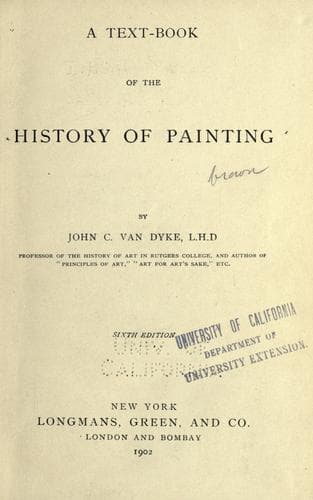
A Text-Book of the History of PaintingVan Dyke, John C.
History
A Text-Book of the History of Painting
Van Dyke, John C.
Painting -- History
Mazo (1610?-1667), pupil and son-in-law of Velasquez, was one of his
most facile imitators, and Carreno de Miranda (1614-1685) was
influenced by Velasquez, and for a time his assistant. The Castilian
school may be said to have closed with these late men and with Claudio
Coello (1635?-1693), a painter with a style founded on Titian and
Rubens, whose best work was of extraordinary power. Spanish painting
went out with Spanish power, and only isolated men of small rank
remained.
ANDALUSIAN SCHOOL: This school came into existence about the middle of
the sixteenth century. Its chief centre was at Seville, and its chief
patron the Church rather than the king. Vargas (1502-1568) was
probably the real founder of the school, though De Castro (fl. 1454)
and others preceded him. Vargas was a man of much reputation and
ability in his time, and introduced Italian methods and elegance into
the Andalusian school after twenty odd years of residence in Italy. He
is said to have studied under Perino del Vaga, and there is some
sweetness of face and grace of form about his work that point that
way, though his composition suggests Correggio. Most of his frescos
have perished; some of his canvases are still in existence.
Cespedes (1538?-1608) is little known through extant works, but he
achieved fame in many departments during his life, and is said to have
been in Italy under Florentine influence. His coloring was rather
cold, and his drawing large and flat. The best early painter of the
school was Roelas (1558?-1625), the inspirer of Murillo and the master
of Zurbaran. He is supposed to have studied at Venice, because of his
rich, glowing color. Most of his works are religious and are found
chiefly at Seville. He was greatly patronized by the Jesuits. Pacheco
(1571-1654) was more of a pedant than a painter, a man of rule, who
to-day might be written down an academician. His drawing was hard, and
perhaps the best reason for his being remembered is that he was one of
the masters and the father-in-law of Velasquez. His rival, Herrera the
Elder (1576?-1656) was a stronger man--in fact, the most original
artist of his school. He struck off by himself and created a bold
realism with a broad brush that anticipated Velasquez--in fact,
Velasquez was under him for a time.
Public-domain text, read in full here on John Shaqi.
Reviews
Reviews
No reviews yet
Be the first to share your thoughts on this work.
Elsewhere in the archive
Join the Discussion
Join the discussion
Sign in to leave a comment or review.
Sign InorCreate an account