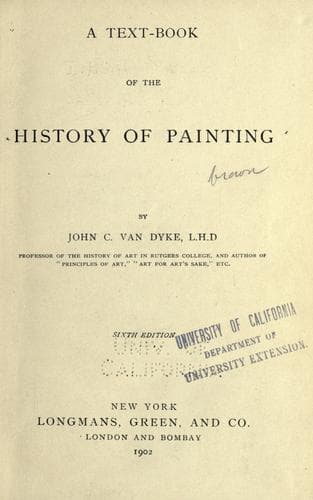
A Text-Book of the History of PaintingVan Dyke, John C.
History
A Text-Book of the History of Painting
Van Dyke, John C.
Painting -- History
After Goya's death Spanish art, such as it was, rather followed
France, with the extravagant classicism of David as a model. What was
produced may be seen to this day in the Madrid Museum. It does not
call for mention here. About the beginning of the 1860's Spanish
painting made a new advance with Mariano Fortuny (1838-1874). In his
early years he worked at historical painting, but later on he went to
Algiers and Rome, finding his true vent in a bright sparkling painting
of _genre_ subjects, oriental scenes, streets, interiors, single
figures, and the like. He excelled in color, sunlight effects, and
particularly in a vivacious facile handling of the brush. His work is
brilliant, and in his late productions often spotty from excessive
use of points of light in high color. He was a technician of much
brilliancy and originality, his work exciting great admiration in his
day, and leading the younger painters of Spain into that ornate
handling visible in their works at the present time. Many of these
latter, from association with art and artists in Paris, have adopted
French methods, and hardly show such a thing as Spanish nationality.
Fortuny's brother-in-law, Madrazo (1841-), is an example of a Spanish
painter turned French in his methods--a facile and brilliant
portrait-painter. Zamacois (1842-1871) died early, but with a
reputation as a successful portrayer of seventeenth-century subjects a
little after the style of Meissonier and not unlike Gerome. He was a
good colorist and an excellent painter of textures.
[Illustration: FIG. 73.--MADRAZO, UNMASKED.]
The historical scene of Mediaeval or Renaissance times, pageants and
fetes with rich costume, fine architecture and vivid effects of color,
are characteristic of a number of the modern Spaniards--Villegas,
Pradilla, Alvarez. As a general thing their canvases are a little
flashy, likely to please at first sight but grow wearisome after a
time. Palmaroli has a style that resembles a mixture of Fortuny and
Meissonier; and some other painters, like Luis Jiminez Aranda,
Sorolla, Zuloaga, Anglada, Garcia y Remos, Vierge, Roman Ribera, and
Domingo, have done excellent work. In landscape and Venetian scenes
Rico leads among the Spaniards with a vivacity and brightness not
always seen to good advantage in his late canvases.
PRINCIPAL WORKS: Generally speaking, Spanish art cannot be
seen to advantage outside of Spain. Both its ancient and
modern masterpieces are at Madrid, Seville, Toledo, and
elsewhere. The Royal Gallery at Madrid has the most and the
best examples.
Public-domain text, read in full here on John Shaqi.
Reviews
Reviews
No reviews yet
Be the first to share your thoughts on this work.
Elsewhere in the archive
Join the Discussion
Join the discussion
Sign in to leave a comment or review.
Sign InorCreate an account