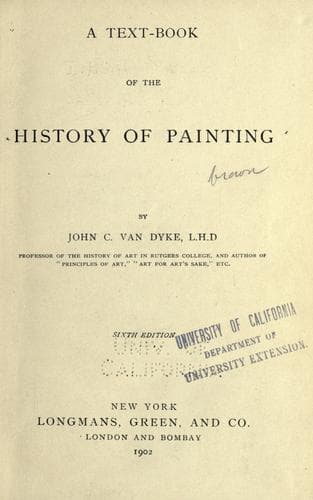
A Text-Book of the History of PaintingVan Dyke, John C.
History
A Text-Book of the History of Painting
Van Dyke, John C.
Painting -- History
SCHOOL OF VALENCIA: This school rose contemporary with the Andalusian
school, into which it was finally merged after the importance of
Madrid had been established. It was largely modelled upon Italian
painting, as indeed were all the schools of Spain at the start. Juan
de Joanes (1507?-1579) apparently was its founder, a man who painted a
good portrait, but in other respects was only a fair imitator of
Raphael, whom he had studied at Rome. A stronger man was Francisco de
Ribalta (1550?-1628), who was for a time in Italy under the Caracci,
and learned from them free draughtsmanship and elaborate composition.
He was also fond of Sebastiano del Piombo, and in his best works (at
Valencia) reflected him. Ribalta gave an early training to Ribera
(1588-1656), who was the most important man of this school. In reality
Ribera was more Italian than Valencian, for he spent the greater part
of his life in Italy, where he was called Lo Spagnoletto, and was
greatly influenced by Caravaggio. He was a Spaniard in the horrible
subjects that he chose, but in coarse strength of line, heaviness of
shadows, harsh handling of the brush, he was a true Neapolitan
Darkling. A pronounced mannerist he was no less a man of strength, and
even in his shadow-saturated colors a painter with the color instinct.
In Italy his influence in the time of the Decadence was wide-spread,
and in Spain his Italian pupil, Giordano, introduced his methods for
late imitation. There were no other men of much rank in the Valencian
school, and, as has been said, the school was eventually merged in
Andalusian painting.
EIGHTEENTH AND NINETEENTH-CENTURY PAINTING IN SPAIN: Almost directly
after the passing of Velasquez and Murillo Spanish art failed. The
eighteenth-century, as in Italy, was quite barren of any considerable
art until near its close. Then Goya (1746-1828) seems to have made a
partial restoration of painting. He was a man of peculiarly Spanish
turn of mind, fond of the brutal and the bloody, picturing inquisition
scenes, bull-fights, battle pieces, and revelling in caricature,
sarcasm, and ridicule. His imagination was grotesque and horrible, but
as a painter his art was based on the natural, and was exceedingly
strong. In brush-work he followed Velasquez; in a peculiar forcing of
contrasts in light and dark he was apparently quite himself, though
possibly influenced by Ribera's work. His best work shows in his
portraits and etchings.
Public-domain text, read in full here on John Shaqi.
Reviews
Reviews
No reviews yet
Be the first to share your thoughts on this work.
Elsewhere in the archive
Join the Discussion
Join the discussion
Sign in to leave a comment or review.
Sign InorCreate an account