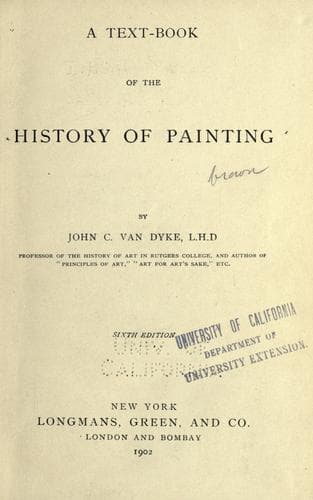
A Text-Book of the History of PaintingVan Dyke, John C.
History
A Text-Book of the History of Painting
Van Dyke, John C.
Painting -- History
Quentin Massys (1460?-1530) and Mostert (1474-1556?), a Dutchman by
birth, but, like Bouts, Flemish by influence, were among the last of
the Gothic painters in Flanders, and yet they began the introduction
of Italian features in their painting. Massys led in architectural
backgrounds, and from that the Italian example spread to subjects,
figures, methods, until the indigenous Flemish art became a thing of
the past. Massys was, at Antwerp, the most important painter of his
day, following the old Flemish methods with many improvements. His
work was detailed, and yet executed with a broader, freer brush than
formerly, and with more variety in color, modelling, expression of
character. He increased figures to almost life-size, giving them
greater importance than landscape or architecture. The type was still
lean and angular, and often contorted with emotion. His Money-Changers
and Misers (many of them painted by his son) were a _genre_ of his
own. With him closed the Gothic school, and with him began the
ANTWERP SCHOOL, the pupils of which went to Italy, and eventually
became Italianized. Mabuse (1470?-1541) was the first to go. His early
work shows the influence of Massys and David. He was good in
composition, color, and brush-work, but lacked in originality, as did
all the imitators of Italy. Franz Floris (1518?-1570) was a man of
talent, much admired in his time, because he brought back
reminiscences of Michael Angelo to Antwerp. His influence was fatal
upon his followers, of whom there were many, like the Franckens and De
Vos. Italy and Roman methods, models, architecture, subjects, began to
rule everywhere.
From Brussels Barent van Orley (1491?-1542) left early for Italy, and
became essentially Italian, though retaining some Flemish color. He
painted in oil, tempera, and for glass, and is supposed to have gained
his brilliant colors by using a gilt ground. His early works remind
one of David. Cocxie (1499-1592), the Flemish Raphael, was but an
indifferent imitator of the Italian Raphael. At Liege the Romanists,
so called, began with Lambert Lombard (1505-1566), of whose work
nothing authentic remains except drawings. At Bruges Peeter Pourbus
(1510?-1584) was about the last one of the good portrait-painters of
the time. Another excellent portrait-painter, a pupil of Scorel, was
Antonio Moro (1512?-1578?). He had much dignity, force, and
elaborateness of costume, and stood quite by himself. There were other
painters of the time who were born or trained in Flanders, and yet
became so naturalized in other countries that in their work they do
not belong to Flanders. Neuchatel (1527?-1590?), Geldorp (1553-1616?),
Calvaert (1540?-1619), Spranger (1546-1627?), and others, were of this
group.
Public-domain text, read in full here on John Shaqi.
Reviews
Reviews
No reviews yet
Be the first to share your thoughts on this work.
Elsewhere in the archive
Join the Discussion
Join the discussion
Sign in to leave a comment or review.
Sign InorCreate an account