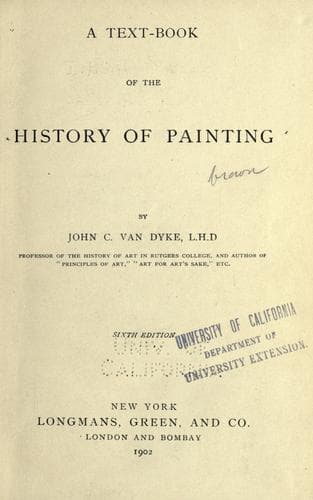
A Text-Book of the History of PaintingVan Dyke, John C.
History
A Text-Book of the History of Painting
Van Dyke, John C.
Painting -- History
Among all the strugglers in Italian imitation only a few landscapists
held out for the Flemish view. Paul Bril (1554-1626) was the first of
them. He went to Italy, but instead of following the methods taught
there, he taught Italians his own view of landscape. His work was a
little dry and formal, but graceful in composition, and good in light
and color. The Brueghels--there were three of them--also stood out for
Flemish landscape, introducing it nominally as a background for small
figures, but in reality for the beauty of the landscape itself.
[Illustration: FIG. 77.--RUBENS. PORTRAIT OF YOUNG WOMAN. HERMITAGE,
ST. PETERSBURGH.]
SEVENTEENTH-CENTURY PAINTING: This was the great century of Flemish
painting, though the painting was not entirely Flemish in method or
thought. The influence of Italy had done away with the early simplicity,
purity, and religious pathos of the Van Eycks. During the sixteenth
century everything had run to bald imitation of Renaissance methods.
Then came a new master-genius, Rubens (1577-1640), who formed a new art
founded in method upon Italy, yet distinctly northern in character.
Rubens chose all subjects for his brush, but the religious altar-piece
probably occupied him as much as any. To this he gave little of Gothic
sentiment, but everything of Renaissance splendor. His art was more
material than spiritual, more brilliant and startling in sensuous
qualities, such as line and color, than charming by facial expression or
tender feeling. Something of the Paolo Veronese cast of mind, he
conceived things largely, and painted them proportionately--large
Titanic types, broad schemes and masses of color, great sweeping lines
of beauty. One value of this largeness was its ability to hold at a
distance upon wall or altar. Hence, when seen to-day, close at hand, in
museums, people are apt to think Rubens's art coarse and gross.
There is no prettiness about his type. It is not effeminate or
sentimental, but rather robust, full of life and animal spirits, full
of blood, bone, and muscle--of majestic dignity, grace, and power, and
glowing with splendor of color. In imagination, in conception of art
purely as art, and not as a mere vehicle to convey religious or
mythological ideas, in mental grasp of the pictorial world, Rubens
stands with Titian and Velasquez in the very front rank of painters.
As a technician, he was unexcelled. A master of composition,
modelling, and drawing, a master of light, and a color-harmonist of
the rarest ability, he, in addition, possessed the most certain,
adroit, and facile hand that ever handled a paint-brush. Nothing could
be more sure than the touch of Rubens, nothing more easy and
masterful. He was trained in both mind and eye, a genius by birth and
by education, a painter who saw keenly, and was able to realize what
he saw with certainty.
Public-domain text, read in full here on John Shaqi.
Reviews
Reviews
No reviews yet
Be the first to share your thoughts on this work.
Elsewhere in the archive
Join the Discussion
Join the discussion
Sign in to leave a comment or review.
Sign InorCreate an account