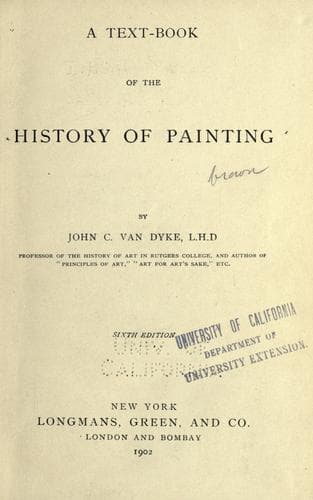
A Text-Book of the History of PaintingVan Dyke, John C.
History
A Text-Book of the History of Painting
Van Dyke, John C.
Painting -- History
There were a number of Rubens's pupils, like Diepenbeeck (1596-1675),
who learned from their master a certain brush facility, but were not
sufficiently original to make deep impressions. When Rubens died the
best painter left in Belgium was Jordaens (1593-1678). He was a pupil
of Van Noort, but submitted to the Rubens influence and followed in
Rubens's style, though more florid in coloring and grosser in types.
He painted all sorts of subjects, but was seen at his best in
mythological scenes with groups of drunken satyrs and bacchants,
surrounded by a close-placed landscape. He was the most independent
and original of the followers, of whom there was a host. Crayer
(1582-1669), Janssens (1575-1632), Zegers (1591-1651), Rombouts
(1597-1637), were the prominent ones. They all took an influence more
or less pronounced from Rubens. Cornelius de Vos (1585-1651) was a
more independent man--a realistic portrait-painter of much ability.
Snyders (1579-1657), and Fyt (1609?-1661), devoted their brushes to
the painting of still-life, game, fruits, flowers, landscape--Snyders
often in collaboration with Rubens himself.
[Illustration: FIG. 79.--TENIERS THE YOUNGER. PRODIGAL SON. LOUVRE.]
Living at the same time with these half-Italianized painters, and
continuing later in the century, there was another group of painters
in the Low Countries who were emphatically of the soil, believing in
themselves and their own country and picturing scenes from commonplace
life in a manner quite their own. These were the "Little Masters," the
_genre_ painters, of whom there was even a stronger representation
appearing contemporaneously in Holland. In Belgium there were not so
many nor such talented men, but some of them were very interesting in
their work as in their subjects. Teniers the Younger (1610-1690) was
among the first of them to picture peasant, burgher, alewife, and
nobleman in all scenes and places. Nothing escaped him as a subject,
and yet his best work was shown in the handling of low life in
taverns. There is coarse wit in his work, but it is atoned for by
good color and easy handling. He was influenced by Rubens, though
decidedly different from him in many respects. Brouwer (1606?-1638)
has often been catalogued with the Holland school, but he really
belongs with Teniers, in Belgium. He died early, but left a number of
pictures remarkable for their fine "fat" quality and their beautiful
color. He was not a man of Italian imagination, but a painter of low
life, with coarse humor and not too much good taste, yet a superb
technician and vastly beyond many of his little Dutch contemporaries
at the North. Teniers and Brouwer led a school and had many followers.
Public-domain text, read in full here on John Shaqi.
Reviews
Reviews
No reviews yet
Be the first to share your thoughts on this work.
Elsewhere in the archive
Join the Discussion
Join the discussion
Sign in to leave a comment or review.
Sign InorCreate an account