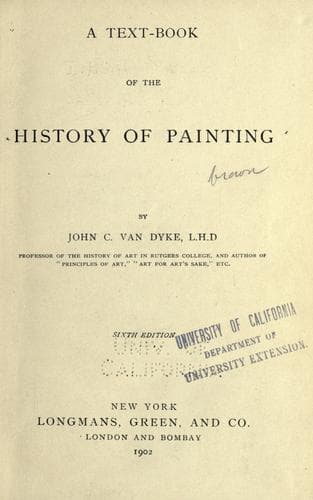
A Text-Book of the History of PaintingVan Dyke, John C.
History
A Text-Book of the History of Painting
Van Dyke, John C.
Painting -- History
Well-born, ennobled by royalty, successful in both court and studio,
Rubens lived brilliantly and his life was a series of triumphs. He
painted enormous canvases, and the number of pictures, altar-pieces,
mythological decorations, landscapes, portraits scattered throughout
the galleries of Europe, and attributed to him, is simply amazing. He
was undoubtedly helped in many of his canvases by his pupils, but the
works painted by his own hand make a world of art in themselves. He
was the greatest painter of the North, a full-rounded, complete
genius, comparable to Titian in his universality. His precursors and
masters, Van Noort (1562-1641) and Vaenius (1558-1629), gave no strong
indication of the greatness of Ruben's art, and his many pupils,
though echoing his methods, never rose to his height in mental or
artistic grasp.
[Illustration: FIG. 78.--VAN DYCK. PORTRAIT OF CORNELIUS VAN DER
GEEST. NAT. GAL. LONDON.]
Van Dyck (1599-1641) was his principal pupil. He followed Rubens
closely at first, though in a slighter manner technically, and with a
cooler coloring. After visiting Italy he took up with the warmth of
Titian. Later, in England, he became careless and less certain. His
rank is given him not for his figure-pieces. They were not always
successful, lacking as they did in imagination and originality, though
done with force. His best work was his portraiture, for which he
became famous, painting nobility in every country of Europe in which
he visited. At his best he was a portrait-painter of great power, but
not to be placed in the same rank with Titian, Rubens, Rembrandt, and
Velasquez. His characters are gracefully posed, and appear to be
aristocratic. There is a noble distinction about them, and yet even
this has the feeling of being somewhat affected. The serene
complacency of his lords and ladies finally became almost a mannerism
with him, though never a disagreeable one. He died early, a painter of
mark, but not the greatest portrait-painter of the world, as is
sometimes said of him.
Public-domain text, read in full here on John Shaqi.
Reviews
Reviews
No reviews yet
Be the first to share your thoughts on this work.
Elsewhere in the archive
Join the Discussion
Join the discussion
Sign in to leave a comment or review.
Sign InorCreate an account