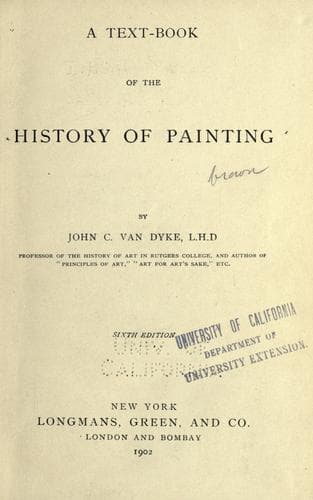
A Text-Book of the History of PaintingVan Dyke, John C.
History
A Text-Book of the History of Painting
Van Dyke, John C.
Painting -- History
SEVENTEENTH CENTURY: Beginning with the first quarter of this century
came the great art of the Dutch people, founded on themselves and
rooted in their native character. Italian methods were abandoned, and
the Dutch told the story of their own lives in their own manner, with
truth, vigor, and skill. There were so many painters in Holland during
this period that it will be necessary to divide them into groups and
mention only the prominent names.
PORTRAIT AND FIGURE PAINTERS: The real inaugurators of Dutch
portraiture were Mierevelt, Hals, Ravesteyn, and De Keyser. Mierevelt
(1567-1641) was one of the earliest, a prolific painter, fond of the
aristocratic sitter, and indulging in a great deal of elegance in his
accessories of dress and the like. He had a slight, smooth brush, much
detail, and a profusion of color. Quite the reverse of him was Franz
Hals (1584?-1666), one of the most remarkable painters of portraits
with which history acquaints us. In giving the sense of life and
personal physical presence, he was unexcelled by any one. What he saw
he could portray with the most telling reality. In drawing and
modelling he was usually good; in coloring he was excellent, though in
his late work sombre; in brush-handling he was one of the great
masters. Strong, virile, yet easy and facile, he seemed to produce
without effort. His brush was very broad in its sweep, very sure, very
true. Occasionally in his late painting facility ran to the
ineffectual, but usually he was certainty itself. His best work was in
portraiture, and the most important of this is to be seen at Haarlem,
where he died after a rather careless life. As a painter, pure and
simple, he is almost to be ranked beside Velasquez; as a poet, a
thinker, a man of lofty imagination, his work gives us little
enlightenment except in so far as it shows a fine feeling for masses
of color and problems of light. Though excellent portrait-painters,
Ravesteyn (1572?-1657) and De Keyser (1596?-1679) do not provoke
enthusiasm. They were quiet, conservative, dignified, painting civic
guards and societies with a knowing brush and lively color, giving the
truth of physiognomy, but not with that verve of the artist so
conspicuous in Hals, nor with that unity of the group so essential in
the making of a picture.
[Illustration: FIG. 82.--REMBRANDT. HEAD OF WOMAN. NAT. GAL. LONDON.]
Public-domain text, read in full here on John Shaqi.
Reviews
Reviews
No reviews yet
Be the first to share your thoughts on this work.
Elsewhere in the archive
Join the Discussion
Join the discussion
Sign in to leave a comment or review.
Sign InorCreate an account