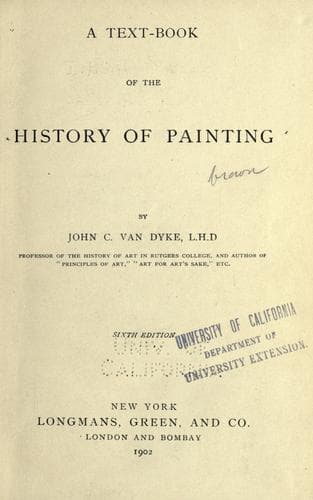
A Text-Book of the History of PaintingVan Dyke, John C.
History
A Text-Book of the History of Painting
Van Dyke, John C.
Painting -- History
The next man in chronological order is Rembrandt (1607?-1669), the
greatest painter in Dutch art. He was a pupil of Swanenburch and
Lastman, but his great knowledge of nature and his craft came largely
from the direct study of the model. Settled at Amsterdam, he quickly
rose to fame, had a large following of pupils, and his influence was
felt through all Dutch painting. The portrait was emphatically his
strongest work. The many-figured group he was not always successful in
composing or lighting. His method of work rather fitted him for the
portrait and unfitted him for the large historical piece. He built up
the importance of certain features by dragging down all other
features. This was largely shown in his handling of illumination.
Strong in a few high lights on cheek, chin, or white linen, the rest
of the picture was submerged in shadow, under which color was
unmercifully sacrificed. This was not the best method for a large,
many-figured piece, but was singularly well suited to the portrait. It
produced strength by contrast. "Forced" it was undoubtedly, and not
always true to nature, yet nevertheless most potent in Rembrandt's
hands. He was an arbitrary though perfect master of light-and-shade,
and unusually effective in luminous and transparent shadows. In color
he was again arbitrary but forcible and harmonious. In brush-work he
was at times labored, but almost always effective.
Mentally he was a man keen to observe, assimilate, and express his
impressions in a few simple truths. His conception was localized with
his own people and time (he never built up the imaginary or followed
Italy), and yet into types taken from the streets and shops of
Amsterdam he infused the very largest humanity through his inherent
sympathy with man. Dramatic, even tragic, he was; yet this was not so
apparent in vehement action as in passionate expression. He had a
powerful way of striking universal truths through the human face, the
turned head, bent body, or outstretched hand. His people have
character, dignity, and a pervading feeling that they are the great
types of the Dutch race--people of substantial physique, slow in
thought and impulse, yet capable of feeling, comprehending, enjoying,
suffering.
His landscapes, again, were a synthesis of all landscapes, a grouping
of the great truths of light, air, shadow, space. Whatever he turned
his hand to was treated with that breadth of view that overlooked the
little and grasped the great. He painted many subjects. His earliest
work dates from 1627, and is a little hard and sharp in detail and
cold in coloring. After 1654 he grew broader in handling and warmer in
tone, running to golden browns, and, toward the end of his career, to
rather hot tones. His life was embittered by many misfortunes, but
these never seem to have affected his art except to deepen it. He
painted on to the last, convinced that his own view was the true one,
and producing works that rank second to none in the history of
painting.
Public-domain text, read in full here on John Shaqi.
Reviews
Reviews
No reviews yet
Be the first to share your thoughts on this work.
Elsewhere in the archive
Join the Discussion
Join the discussion
Sign in to leave a comment or review.
Sign InorCreate an account