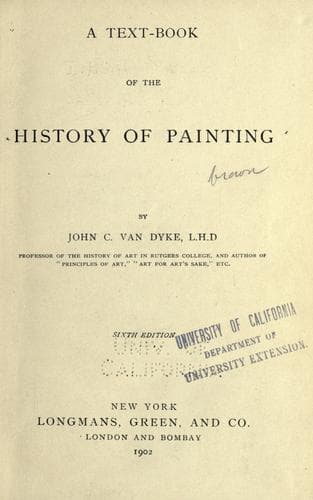
A Text-Book of the History of PaintingVan Dyke, John C.
History
A Text-Book of the History of Painting
Van Dyke, John C.
Painting -- History
a few, again, are so free and mellow that they look as though done by
another hand. He was usually minute in detail, especially in such
features as hair, cloth, flesh. His portraits were uneven and not his
best productions. He was too close a scrutinizer of the part and not
enough of an observer of the whole for good portraiture. Indeed, that
is the criticism to be made upon all his work. He was an exquisite
realist of certain features, but not always of the _ensemble_.
Nevertheless he holds first rank in the German art of the Renaissance,
not only on account of his technical ability, but also because of his
imagination, sincerity, and striking originality.
[Illustration: FIG. 90.--HOLBEIN THE YOUNGER. PORTRAIT. HAGUE MUS.]
Duerer's influence was wide-spread throughout Germany, especially in
engraving, of which he was a master. In painting Schaeufelin
(1490?-1540?) was probably his apprentice, and in his work followed
the master so closely that many of his works have been attributed to
Duerer. This is true in measure of Hans Baldung (1476?-1552?). Hans von
Kulmbach (?-1522) was a painter of more than ordinary importance,
brilliant in coloring, a follower of Duerer, who was inclined toward
Italian methods, an inclination that afterward developed all through
German art. Following Duerer's formulas came a large number of
so-called "Little Masters" (from the size of their engraved plates),
who were more engravers than painters. Among the more important of
those who were painters as well as engravers were Altdorfer
(1480?-1538), a rival rather than an imitator of Duerer; Barthel Beham
(1502-1540), Sebald Beham (1500-1550), Pencz (1500?-1550), Aldegrever
(1502-1558), and Bink (1490?-1569?).
SWABIAN SCHOOL: This school includes a number of painters who were
located at different places, like Colmar and Ulm, and later on it
included the Holbeins at Augsburg, who were really the consummation of
the school. In the fifteenth century one of the early leaders was
Martin Schoengauer (1446?-1488), at Colmar. He is supposed to have been
a pupil of Roger Van der Weyden, of the Flemish school, and is better
known by his engravings than his paintings, none of the latter being
positively authenticated. He was thoroughly German in his type and
treatment, though, perhaps, indebted to the Flemings for his coloring.
There was some angularity in his figures and draperies, and a tendency
to get nearer nature and further away from the ecclesiastical and
ascetic conception in all that he did.
Public-domain text, read in full here on John Shaqi.
Reviews
Reviews
No reviews yet
Be the first to share your thoughts on this work.
Elsewhere in the archive
Join the Discussion
Join the discussion
Sign in to leave a comment or review.
Sign InorCreate an account