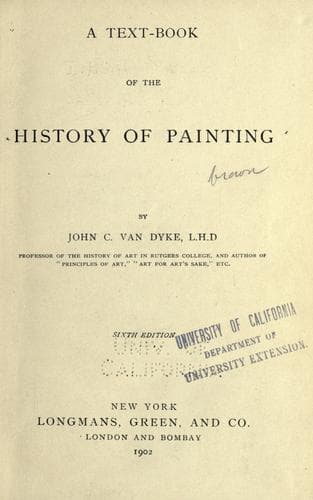
A Text-Book of the History of PaintingVan Dyke, John C.
History
A Text-Book of the History of Painting
Van Dyke, John C.
Painting -- History
At Ulm a local school came into existence with Zeitblom (fl.
1484-1517), who was probably a pupil of Schuechlin. He had neither
Schoengauer's force nor his fancy, but was a simple, straightforward
painter of one rather strong type. His drawing was not good, except in
the draperies, but he was quite remarkable for the solidity and
substance of his painting, considering the age he lived in was given
to hard, thin brush-work. Schaffner (fl. 1500-1535) was another Ulm
painter, a junior to Zeitblom, of whom little is known, save from a
few pictures graceful and free in composition. A recently discovered
man, Bernard Strigel (1461?-1528?) seems to have been excellent in
portraiture.
[Illustration: FIG. 91.--PILOTY. WISE AND FOOLISH VIRGINS.]
At Augsburg there was still another school, which came into prominence
in the sixteenth century with Burkmair and the Holbeins. It was only a
part of the Swabian school, a concentration of artistic force about
Augsburg, which, toward the close of the fifteenth century, had come
into competition with Nuremberg, and rather outranked it in splendor.
It was at Augsburg that the Renaissance art in Germany showed in more
restful composition, less angularity, better modelling and painting,
and more sense of the _ensemble_ of a picture. Hans Burkmair
(1473-1531) was the founder of the school, a pupil of Schoengauer,
later influenced by Duerer, and finally showing the influence of
Italian art. He was not, like Duerer, a religious painter, though doing
religious subjects. He was more concerned with worldly appearance, of
which he had a large knowledge, as may be seen from his illustrations
for engraving. As a painter he was a rather fine colorist, indulging
in the fantastic of architecture but with good taste, crude in
drawing but forceful, and at times giving excellent effects of motion.
He was rounder, fuller, calmer in composition than Duerer, but never so
strong an artist.
Next to Burkmair comes the celebrated Holbein family. There were four
of them all told, but only two of them, Hans the Elder and Hans the
Younger, need be mentioned. Holbein the Elder (1460?-1524), after
Burkmair, was the best painter of his time and school without being in
himself a great artist. Schoengauer was at first his guide, though he
soon submitted to some Flemish and Cologne influence, and later on
followed Italian form and method in composition to some extent. He was
a good draughtsman, and very clever at catching realistic points of
physiognomy--a gift he left his son Hans. In addition he had some
feeling for architecture and ornament, and in handling was a bit hard,
and oftentimes careless. The best half of his life fell in the latter
part of the fifteenth century, and he never achieved the free
painter's quality of his son.
Public-domain text, read in full here on John Shaqi.
Reviews
Reviews
No reviews yet
Be the first to share your thoughts on this work.
Elsewhere in the archive
Join the Discussion
Join the discussion
Sign in to leave a comment or review.
Sign InorCreate an account