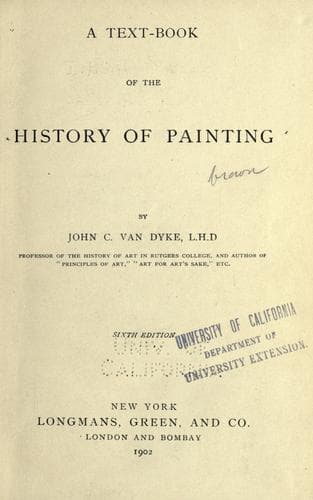
A Text-Book of the History of PaintingVan Dyke, John C.
History
A Text-Book of the History of Painting
Van Dyke, John C.
Painting -- History
The whole academic tendency of modern painting in Germany and Austria
for the past fifty years has not been favorable to the best kind of
pictorial art. There is a disposition on the part of artists to tell
stories, to encroach upon the sentiment of literature, to paint with a
dry brush in harsh unsympathetic colors, to ignore relations of
light-and-shade, and to slur beauties of form. The subject seems to
count for more than the truth of representation, or the individuality
of view. From time to time artists of much ability have appeared, but
these form an exception rather than a rule. The men to-day who are the
great artists of Germany are less followers of the German tradition
than individuals each working in a style peculiar to himself. A few
only of them call for mention. Menzel (1815-1905) is easily first, a
painter of group pictures, a good colorist, and a powerful pen-and-ink
draughtsman; Lenbach (1836-1904), a forceful portraitist; Uhde
(1848-), a portrayer of scriptural scenes in modern costumes with much
sincerity, good color, and light; Leibl (1844-1900), an artist with
something of the Holbein touch and realism; Thoma, a Frankfort painter
of decorative friezes and panels; Liebermann, Gotthardt Kuehl, Franz
Stuck, Max Klinger, Greiner, Truebner, Bartels, Keller.
[Illustration: FIG. 93.--MENZEL. A READER.]
Aside from these men there are several notable painters with German
affinities, like Makart (1840-1884), an Austrian, who possessed good
technical qualities and indulged in a profusion of color; Munkacsy
(1846-1900), a Hungarian, who is perhaps more Parisian than German in
technic, and Boecklin (1827-1901), a Swiss, who is quite by himself in
fantastic and grotesque subjects, a weird and uncanny imagination, and
a brilliant prismatic coloring.
PRINCIPAL WORKS: BOHEMIAN SCHOOL--Theoderich of Prague,
Karlstein chap. and University Library Prague, Vienna Mus.;
Wurmser, same places.
FRANCONIAN SCHOOL--Wolgemut, Aschaffenburg, Munich,
Nuremberg, Cassel Mus.; Duerer, Crucifixion Dresden, Trinity
Vienna Mus., other works Munich, Nuremberg, Madrid Mus.;
Schaeufelin, Basle, Bamberg, Cassel, Munich, Nuremberg,
Nordlingen Mus., and Ulm Cathedral; Baldung, Aschaffenburg,
Basle, Berlin, Kunsthalle Carlsruhe, Freiburg Cathedral;
Kulmbach, Munich, Nuremberg, Oldenburg; Altdorfer and the
"Little Masters" are seen in the Augsburg, Nuremberg,
Berlin, Munich and Fuerstenberg Mus.
Public-domain text, read in full here on John Shaqi.
Reviews
Reviews
No reviews yet
Be the first to share your thoughts on this work.
Elsewhere in the archive
Join the Discussion
Join the discussion
Sign in to leave a comment or review.
Sign InorCreate an account