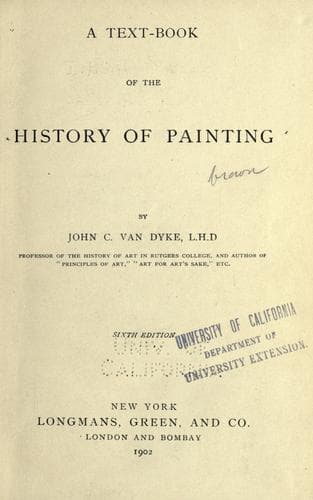
A Text-Book of the History of PaintingVan Dyke, John C.
History
A Text-Book of the History of Painting
Van Dyke, John C.
Painting -- History
NINETEENTH CENTURY: In the first part of this century there started in
Germany a so-called "revival of art" led by Overbeck (1789-1869),
Cornelius (1783-1867), Veit (1793-1877), and Schadow (1789-1862), but
like many another revival of art it did not amount to much. The
attempt to "revive" the past is usually a failure. The forms are
caught, but the spirit is lost. The nineteenth-century attempt in
Germany was brought about by the study of monumental painting in
Italy, and the taking up of the religious spirit in a pre-Raphaelite
manner. Something also of German romanticism was its inspiration.
Overbeck remained in Rome, but the others, after some time in Italy,
returned to Germany, diffused their teaching, and really formed a new
epoch in German painting. A modern art began with ambitions and
subjects entirely disproportionate to its skill. The monumental, the
ideal, the classic, the exalted, were spread over enormous spaces, but
there was no reason for such work in the contemporary German life, and
nothing to warrant its appearance save that its better had appeared in
Italy during the Renaissance. Cornelius after his return became the
head of the
MUNICH SCHOOL and painted pictures of the heroes of the classic and
the Christian world upon a large scale. Nothing but their size and
good intention ever brought them into notice, for their form and
coloring were both commonplace. Schnorr (1794-1872) followed in the
same style with the Niebelungen Lied, Charlemagne, and Barbarossa for
subjects. Kaulbach (1805-1874) was a pupil of Cornelius, and had some
ability but little taste, and not enough originality to produce great
art. Piloty (1826-1886) was more realistic, more of a painter and
ranks as one of the best of the early Munich masters. After him Munich
art became _genre_-like in subject, with greater attention given to
truthful representation in light, color, texture. To-day there are a
large number of painters in the school who are remarkable for
realistic detail.
DUSSELDORF SCHOOL: After 1826 this school came into prominence under
the guidance of Schadow. It did not fancy monumental painting so much
as the common easel picture, with the sentimental, the dramatic, or
the romantic subject. It was no better in either form or color than
the Munich school, in fact not so good, though there were painters who
emanated from it who had ability. At Berlin the inclination was to
follow the methods and ideas held at Dusseldorf.
Public-domain text, read in full here on John Shaqi.
Reviews
Reviews
No reviews yet
Be the first to share your thoughts on this work.
Elsewhere in the archive
Join the Discussion
Join the discussion
Sign in to leave a comment or review.
Sign InorCreate an account