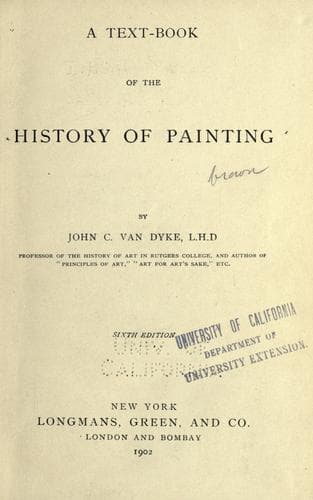
A Text-Book of the History of PaintingVan Dyke, John C.
History
A Text-Book of the History of Painting
Van Dyke, John C.
Painting -- History
Opposed to this flat, unrelieved style was the work of a follower,
Agatharchos of Samos (fl. end of fifth century B.C.). He was a
scene-painter, and by the necessities of his craft was led toward
nature. Stage effect required a study of perspective, variation of
light, and a knowledge of the laws of optics. The slight outline
drawing of his predecessor was probably superseded by effective masses
to create illusion. This was a distinct advance toward nature.
Apollodorus (fl. end of fifth century B.C.) applied the principles of
Agatharchos to figures. According to Plutarch, he was the first to
discover variation in the shade of colors, and, according to Pliny,
the first master to paint objects as they appeared in nature. He had
the title of _skiagraphos_ (shadow-painter), and possibly gave a
semi-natural background with perspective. This was an improvement, but
not a perfection. It is not likely that the backgrounds were other
than conventional settings for the figure. Even these were not at once
accepted by the painters of the period, but were turned to profit in
the hands of the followers.
After the Peloponnesian Wars the art of painting seems to have
flourished elsewhere than in Athens, owing to the Athenian loss of
supremacy. Other schools sprang up in various districts, and one to
call for considerable mention by the ancient writers was the
IONIAN SCHOOL, which in reality had existed from the sixth century.
The painters of this school advanced upon the work of Apollodorus as
regards realistic effect. Zeuxis, whose fame was at its height during
the Peloponnesian Wars, seems to have regarded art as a matter of
illusion, if one may judge by the stories told of his work. The tale
of his painting a bunch of grapes so like reality that the birds came
to peck at them proves either that the painter's motive was deception,
or that the narrator of the tale picked out the deceptive part of his
picture for admiration. He painted many subjects, like Helen,
Penelope, and many _genre_ pieces on panel. Quintilian says he
originated light-and-shade, an achievement credited by Plutarch to
Apollodorus. It is probable that he advanced light-and-shade.
In illusion he seems to have been outdone by a rival, Parrhasios of
Ephesus. Zeuxis deceived the birds with painted grapes, but Parrhasios
deceived Zeuxis with a painted curtain. There must have been knowledge
of color, modelling, and relief to have produced such an illusion, but
the aim was petty and unworthy of the skill. There was evidently an
advance technically, but some decline in the true spirit of art.
Parrhasios finally suffered defeat at the hands of Timanthes of
Kythnos, by a Contest between Ajax and Ulysses for the Arms of
Achilles. Timanthes's famous work was the Sacrifice of Iphigenia, of
which there is a supposed Pompeian copy.
Public-domain text, read in full here on John Shaqi.
Reviews
Reviews
No reviews yet
Be the first to share your thoughts on this work.
Join the Discussion
Join the discussion
Sign in to leave a comment or review.
Sign InorCreate an account