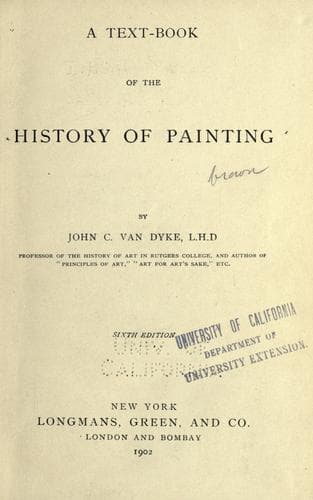
A Text-Book of the History of PaintingVan Dyke, John C.
History
A Text-Book of the History of Painting
Van Dyke, John C.
Painting -- History
The decline continued during the sixth and seventh centuries, owing
somewhat perhaps to the influence of Byzantium and the introduction
into Italy of Eastern types and elements. In the eighth century the
Iconoclastic controversy broke out again in fury with the edict of Leo
the Isaurian. This controversy was a renewal of the old quarrel in the
Church about the use of pictures and images. Some wished them for
instruction in the Word; others decried them as leading to idolatry.
It was a long quarrel of over a hundred years' duration, and a deadly
one for art. When it ended, the artists were ordered to follow the
traditions, not to make any new creations, and not to model any figure
in the round. The nature element in art was quite dead at that time,
and the order resulted only in diverting the course of painting toward
the unrestricted miniatures and manuscripts. The native Italian art
was crushed for a time by this new ecclesiastical burden. It did not
entirely disappear, but it gave way to the stronger, though equally
restricted art that had been encroaching upon it for a long time--the
art of Byzantium.
BYZANTINE PAINTING: Constantinople was rebuilt and rechristened by
Constantine, a Christian emperor, in the year 328 A.D. It became a
stronghold of Christian traditions, manners, customs, art. But it was
not quite the same civilization as that of Rome and the West. It was
bordered on the south and east by oriental influences, and much of
Eastern thought, method, and glamour found its way into the Christian
community. The artists fought this influence, stickling a long time
for the severer classicism of ancient Greece. For when Rome fell the
traditions of the Old World centred around Constantinople. But classic
form was ever being encroached upon by oriental richness of material
and color. The struggle was a long but hopeless one. As in Italy,
form failed century by century. When, in the eighth century, the
Iconoclastic controversy cut away the little Greek existing in it, the
oriental ornament was about all that remained.
Public-domain text, read in full here on John Shaqi.
Reviews
Reviews
No reviews yet
Be the first to share your thoughts on this work.
Join the Discussion
Join the discussion
Sign in to leave a comment or review.
Sign InorCreate an account