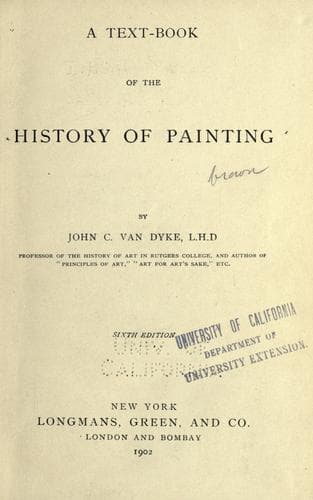
A Text-Book of the History of Painting — John Shaqi
A Text-Book of the History of PaintingVan Dyke, John C.
History
A Text-Book of the History of Painting
Van Dyke, John C.
Painting -- History
There was little advance upon Byzantinism in the work of Guido da
Sienna (fl. 1275). Even Duccio (1260?----?), the real founder of the
Siennese school, retained Byzantine methods and adopted the school
subjects, but he perfected details of form, such as the hands and
feet, and while retaining the long Byzantine face, gave it a
melancholy tenderness of expression. He possessed no dramatic force,
but had a refined workmanship for his time--a workmanship perhaps
better, all told, than that of his Florentine contemporary, Cimabue.
Simone di Martino (1283?-1344?) changed the type somewhat by rounding
the form. His drawing was not always correct, but in color he was good
and in detail exact and minute. He probably profited somewhat by the
example of Giotto.
The Siennese who came the nearest to Giotto's excellence were the
brothers Ambrogio (fl. 1342) and Pietro (fl. 1350) Lorenzetti. There
is little known about them except that they worked together in a
similar manner. The most of their work has perished, but what remains
shows an intellectual grasp equal to any of the age. The Sienna
frescos by Ambrogio Lorenzetti are strong in facial character, and
some of the figures, like that of the white-robed Peace, are beautiful
in their flow of line. Lippo Memmi (?-1356), Bartolo di Fredi
(1330-1410), and Taddeo di Bartolo (1362-1422), were other painters of
the school. The late men rather carried detail to excess, and the
school grew conventional instead of advancing.
TRANSITION PAINTERS: Several painters, Starnina (1354-1413), Gentile
da Fabriano (1360?-1440?), Fra Angelico (1387-1455), have been put
down in art history as the makers of the transition from Gothic to
Renaissance painting. They hardly deserve the title. There was no
transition. The development went on, and these painters, coming late
in the fourteenth century and living into the fifteenth, simply showed
the changing style, the advance in the study of nature and the technic
of art. Starnina's work gave strong evidence of the study of form, but
it was no such work as Masaccio's. There is always a little of the
past in the present, and these painters showed traces of Byzantinism
in details of the face and figure, in coloring, and in gold embossing.
Public-domain text, read in full here on John Shaqi.
Reviews
Reviews
No reviews yet
Be the first to share your thoughts on this work.
Join the Discussion
Join the discussion
Sign in to leave a comment or review.
Sign InorCreate an account