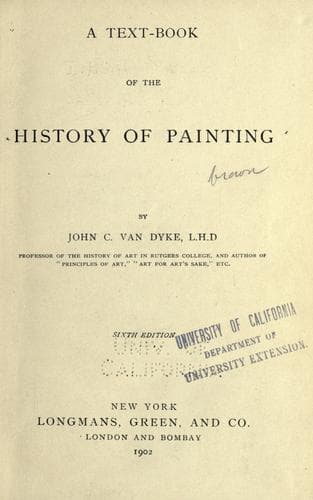
A Text-Book of the History of PaintingVan Dyke, John C.
History
A Text-Book of the History of Painting
Van Dyke, John C.
Painting -- History
THE ITALIAN MIND: There is no way of explaining the Italian fondness
for form and color other than by considering the necessities of the
people and the artistic character of the Italian mind. Art in all its
phases was not only an adornment but a necessity of Christian
civilization. The Church taught people by sculpture, mosaic,
miniature, and fresco. It was an object-teaching, a grasping of ideas
by forms seen in the mind, not a presenting of abstract ideas as in
literature. Printing was not known. There were few manuscripts, and
the majority of people could not read. Ideas came to them for
centuries through form and color, until at last the Italian mind took
on a plastic and pictorial character. It saw things in symbolic
figures, and when the Renaissance came and art took the lead as one of
its strongest expressions, painting was but the color-thought and
form-language of the people.
[Illustration: FIG. 26.--FRA FILIPPO. MADONNA. UFFIZI.]
And these people, by reason of their peculiar education, were an
exacting people, knowing what was good and demanding it from the
artists. Every Italian was, in a way, an art critic, because every
church in Italy was an art school. The artists may have led the
people, but the people spurred on the artists, and so the Italian mind
went on developing and unfolding until at last it produced the great
art of the Renaissance.
THE AWAKENING: The Italian civilization of the fourteenth century was
made up of many impulses and inclinations, none of them very strongly
defined. There was a feeling about in the dark, a groping toward the
light, but the leaders stumbled often on the road. There was good
reason for it. The knowledge of the ancient world lay buried under the
ruins of Rome. The Italians had to learn it all over again, almost
without a precedent, almost without a preceptor. With the fifteenth
century the horizon began to brighten. The Early Renaissance was
begun. It was not a revolt, a reaction, or a starting out on a new
path. It was a development of the Gothic period; and the three
inclinations of the Gothic period--religion, the desire for classic
knowledge, and the study of nature--were carried into the art of the
time with greater realization.
Public-domain text, read in full here on John Shaqi.
Reviews
Reviews
No reviews yet
Be the first to share your thoughts on this work.
Join the Discussion
Join the discussion
Sign in to leave a comment or review.
Sign InorCreate an account