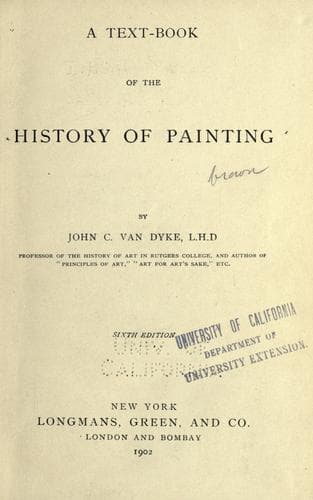
A Text-Book of the History of PaintingVan Dyke, John C.
History
A Text-Book of the History of Painting
Van Dyke, John C.
Painting -- History
Francia at Bologna, but with much of Dosso and Ferrara about him. He,
in common with Imola, already mentioned, was indebted to the art of
Raphael.
CORREGGIO AT PARMA: In Correggio (1494?-1534) all the Boccaccio nature
of the Renaissance came to the surface. It was indicated in Andrea del
Sarto--this nature-worship--but Correggio was the consummation. He was
the Faun of the Renaissance, the painter with whom the beauty of the
human as distinguished from the religious and the classic showed at
its very strongest. Free animal spirits, laughing madonnas, raving
nymphs, excited children of the wood, and angels of the sky pass and
repass through his pictures in an atmosphere of pure sensuousness.
They appeal to us not religiously, not historically, not
intellectually, but sensuously and artistically through their rhythmic
lines, their palpitating flesh, their beauty of color, and in the
light and atmosphere that surround them. He was less of a religionist
than Andrea del Sarto. Religion in art was losing ground in his day,
and the liberality and worldliness of its teachers appeared clearly
enough in the decorations of the Convent of St. Paul at Parma, where
Correggio was allowed to paint mythological Dianas and Cupids in the
place of saints and madonnas. True enough, he painted the religious
subject very often, but with the same spirit of life and joyousness as
profane subjects.
[Illustration: FIG. 46--CORREGGIO. MARRIAGE OF ST. CATHERINE AND
CHRIST. LOUVRE.]
The classic subject seemed more appropriate to his spirit, and yet he
knew and probably cared less about it than the religious subject. His
Dianas and Ledas are only so in name. They have little of the
Hellenic spirit about them, and for the sterner, heroic phases of
classicism--the lofty, the grand--Correggio never essayed them. The
things of this earth and the sweetness thereof seemed ever his aim.
Women and children were beautiful to him in the same way that flowers
and trees and skies and sunsets were beautiful. They were revelations
of grace, charm, tenderness, light, shade, color. Simply to exist and
be glad in the sunlight was sweetness to Correggio. He would have no
Sibylesque mystery, no prophetic austerity, no solemnity, no great
intellectuality. He was no leader of a tragic chorus. The dramatic,
the forceful, the powerful, were foreign to his mood. He was a singer
of lyrics and pastorals, a lover of the material beauty about him, and
it is because he passed by the pietistic, the classic, the literary,
and showed the beauty of physical life as an art motive that he is
called the Faun of the Renaissance. The appellation is not
inappropriate.
Public-domain text, read in full here on John Shaqi.
Reviews
Reviews
No reviews yet
Be the first to share your thoughts on this work.
Elsewhere in the archive
Join the Discussion
Join the discussion
Sign in to leave a comment or review.
Sign InorCreate an account