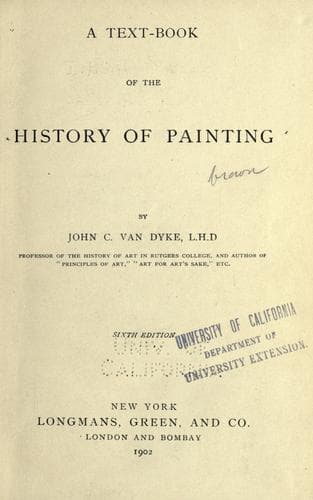
A Text-Book of the History of PaintingVan Dyke, John C.
History
A Text-Book of the History of Painting
Van Dyke, John C.
Painting -- History
How or why he came to take this course would be hard to determine. It
was reflective of the times; but Correggio, so far as history tells
us, had little to do with the movements and people of his age. He was
born and lived and died near Parma, and is sometimes classed among the
Bologna-Ferrara painters, but the reasons for the classification are
not too strong. His education, masters, and influences are all shadowy
and indefinite. He seems, from his drawing and composition, to have
known something of Mantegna at Mantua; from his coloring something of
Dosso and Garofolo, especially in his straw-yellows; from his early
types and faces something of Costa and Francia, and his contours and
light-and-shade indicate a knowledge of Leonardo's work. But there is
no positive certainty that he saw the work of any of these men.
His drawing was faulty at times, but not obtrusively so; his color and
brush-work rich, vivacious, spirited; his light brilliant, warm,
penetrating; his contours melting, graceful; his atmosphere
omnipresent, enveloping. In composition he rather pushed aside line in
favor of light and color. It was his technical peculiarity that he
centralized his light and surrounded it by darks as a foil. And in
this very feature he was one of the first men in Renaissance Italy to
paint a picture for the purpose of weaving a scheme of lights and
darks through a tapestry of rich colors. That is art for art's sake,
and that, as will be seen further on, was the picture motive of the
great Venetians.
Correggio's immediate pupils and followers, like those of Raphael and
Andrea del Sarto, did him small honor. As was usually the case in
Renaissance art-history they caught at the method and lost the spirit
of the master. His son, Pomponio Allegri (1521-1593?), was a painter
of some mark without being in the front rank. Michelangelo Anselmi
(1491-1554?), though not a pupil, was an indifferent imitator of
Correggio. Parmigianino (1504-1540), a mannered painter of some
brilliancy, and of excellence in portraits, was perhaps the best of
the immediate followers. It was not until after Correggio's death, and
with the painters of the Decadence, that his work was seriously taken
up and followed.
Public-domain text, read in full here on John Shaqi.
Reviews
Reviews
No reviews yet
Be the first to share your thoughts on this work.
Elsewhere in the archive
Join the Discussion
Join the discussion
Sign in to leave a comment or review.
Sign InorCreate an account