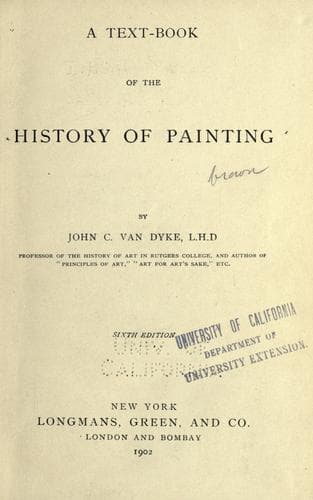
A Text-Book of the History of PaintingVan Dyke, John C.
History
A Text-Book of the History of Painting
Van Dyke, John C.
Painting -- History
PARMESE--Correggio, frescos Convent of S. Paolo, S. Giovanni
Evangelista, Duomo Parma, altar-pieces Dresden (4), Parma
Gals., Louvre, mythological pictures Antiope Louvre, Danae
Borghese, Leda Jupiter and Io Berlin, Venus Mercury and
Cupid Nat. Gal. Lon., Ganymede Vienna Gal.; Pomponio
Allegri, frescos Capella del Popolo Parma; Anselmi, frescos
S. Giovanni Evangelista, altar-pieces Madonna della
Steccata, Duomo, Gal. Parma, Louvre; Parmigianino, frescos
Moses Steccata, S. Giovanni Parma, altar-pieces Santa
Margherita, Bologna Gal., Madonna Pitti, portraits Uffizi,
Vienna, Naples Mus., other works Dresden, Vienna, and Nat.
Gal. Lon.
CHAPTER X.
ITALIAN PAINTING.
THE HIGH RENAISSANCE. 1500-1600. (_Continued._)
BOOKS RECOMMENDED: The works on Italian art before mentioned
and also consult General Bibliography, (page xv.).
THE VENETIAN SCHOOL: It was at Venice and with the Venetian painters
of the sixteenth century that a new art-motive was finally and fully
adopted. This art-motive was not religion. For though the religious
subject was still largely used, the religious or pietistic belief was
not with the Venetians any more than with Correggio. It was not a
classic, antique, realistic, or naturalistic motive. The Venetians
were interested in all phases of nature, and they were students of
nature, but not students of truth for truth's sake.
What they sought, primarily, was the light and shade on a nude
shoulder, the delicate contours of a form, the flow and fall of silk
or brocade, the richness of a robe, a scheme of color or of light, the
character of a face, the majesty of a figure. They were seeking
effects of line, light, color--mere sensuous and pictorial effects, in
which religion and classicism played secondary parts. They believed in
art for art's sake; that painting was a creation, not an illustration;
that it should exist by its pictorial beauties, not by its subject or
story. No matter what their subjects, they invariably painted them so
as to show the beauties they prized the highest. The Venetian
conception was less austere, grand, intellectual, than pictorial,
sensuous, concerning the beautiful as it appealed to the eye. And this
was not a slight or unworthy conception. True it dealt with the
fulness of material life, but regarded as it was by the Venetians--a
thing full-rounded, complete, harmonious, splendid--it became a great
ideal of existence.
[Illustration: FIG. 47.--GIORGIONE(?). ORDEAL OF MOSES. UFFIZI.]
Public-domain text, read in full here on John Shaqi.
Reviews
Reviews
No reviews yet
Be the first to share your thoughts on this work.
Elsewhere in the archive
Join the Discussion
Join the discussion
Sign in to leave a comment or review.
Sign InorCreate an account