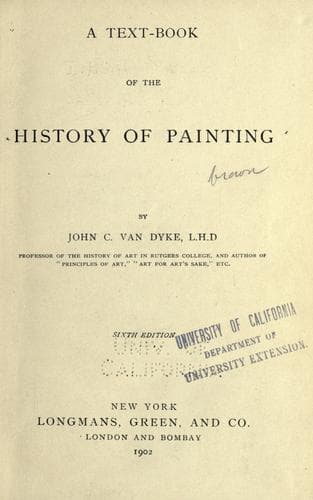
A Text-Book of the History of PaintingVan Dyke, John C.
History
A Text-Book of the History of Painting
Van Dyke, John C.
Painting -- History
In technical expression color was the note of all the school, with
hardly an exception. This in itself would seem to imply a lightness of
spirit, for color is somehow associated in the popular mind with
decorative gayety; but nothing could be further removed from the
Venetian school than triviality. Color was taken up with the greatest
seriousness, and handled in such masses and with such dignified power
that while it pleased it also awed the spectator. Without having quite
the severity of line, some of the Venetian chromatic schemes rise in
sublimity almost to the Sistine modellings of Michael Angelo. We do
not feel this so much in Giovanni Bellini, fine in color as he was. He
came too early for the full splendor, but he left many pupils who
completed what he had inaugurated.
THE GREAT VENETIANS: The most positive in influence upon his
contemporaries of all the great Venetians was Giorgione (1477?-1511).
He died young, and what few pictures by him are left to us have been
so torn to pieces by historical criticism that at times one begins to
doubt if there ever was such a painter. His different styles have been
confused, and his pictures in consequence thereof attributed to
followers instead of to the master. Painters change their styles, but
seldom their original bent of mind. With Giorgione there was a lyric
feeling as shown in music. The voluptuous swell of line, the melting
tone of color, the sharp dash of light, the undercurrent of
atmosphere, all mingled for him into radiant melody. He sought pure
pictorial beauty and found it in everything of nature. He had little
grasp of the purely intellectual, and the religious was something he
dealt with in no strong devotional way. The fete, the concert, the
fable, the legend, with a landscape setting, made a stronger appeal to
him. More of a recorder than a thinker he was not the less a leader
showing the way into that new Arcadian grove of pleasure whose
inhabitants thought not of creeds and faiths and histories and
literatures, but were content to lead the life that was sweet in its
glow and warmth of color, its light, its shadows, its bending trees,
and arching skies. A strong full-blooded race, sober-minded,
dignified, rationally happy with their lot, Giorgione portrayed them
with an art infinite in variety and consummate in skill. Their least
features under his brush seemed to glow like jewels. The sheen of
armor and rich robe, a bare forearm, a nude back, or loosened
hair--mere morsels of color and light--all took on a new beauty. Even
landscape with him became more significant. His master, Bellini, had
been realistic enough in the details of trees and hills, but Giorgione
grasped the meaning of landscape as an entirety, and rendered it with
poetic breadth.
Public-domain text, read in full here on John Shaqi.
Reviews
Reviews
No reviews yet
Be the first to share your thoughts on this work.
Elsewhere in the archive
Join the Discussion
Join the discussion
Sign in to leave a comment or review.
Sign InorCreate an account