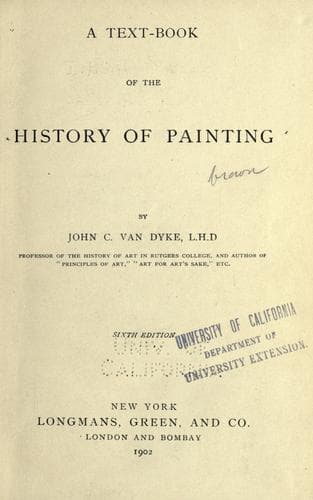
A Text-Book of the History of PaintingVan Dyke, John C.
History
A Text-Book of the History of Painting
Van Dyke, John C.
Painting -- History
Technically he adopted the oil medium brought to Venice by Antonello
da Messina, introducing scumbling and glazing to obtain brilliancy and
depth of color. Of light-and-shade he was a master, and in atmosphere
excellent. He, in common with all the Venetians, is sometimes said to
be lacking in drawing, but that is the result of a misunderstanding.
The Venetians never cared to accent line, choosing rather to model in
masses of light and shadow and color. Giorgione was a superior man
with the brush, but not quite up to his contemporary Titian.
[Illustration: FIG. 48.--TITIAN. VENUS EQUIPPING CUPID. BORGHESE PAL.,
ROME.]
That is not surprising, for Titian (1477-1576) was the painter easily
first in the whole range of Italian art. He was the first man in the
history of painting to handle a brush with freedom, vigor, and gusto.
And Titian's brush-work was probably the least part of his genius.
Calm in mood, dignified, and often majestic in conception, learned
beyond all others in his craft, he mingled thought, feeling, color,
brush-work into one grand and glowing whole. He emphasized nothing,
yet elevated everything. In pure intellectual thought he was not so
strong as Raphael. He never sought to make painting a vehicle for
theological, literary, or classical ideas. His tale was largely of
humanity under a religious or classical name, but a noble, majestic
humanity. In his art dignified senators, stern doges, and solemn
ecclesiastics mingle with open-eyed madonnas, winning Ariadnes, and
youthful Bacchuses. Men and women they are truly, but the very noblest
of the Italian race, the mountain race of the Cadore country--proud,
active, glowing with life; the sea race of Venice--worldly wise, full
of character, luxurious in power.
In himself he was an epitome of all the excellences of painting. He
was everything, the sum of Venetian skill, the crowning genius of
Renaissance art. He had force, power, invention, imagination, point of
view; he had the infinite knowledge of nature and the infinite mastery
of art. In addition, Fortune smiled upon him as upon a favorite child.
Trained in mind and hand he lived for ninety-nine years and worked
unceasingly up to a few months of his death. His genius was great and
his accomplishment equally so. He was celebrated and independent at
thirty-five, though before that he showed something of the influence
of Giorgione. After the death of Giorgione and his master, Bellini,
Titian was the leader in Venice to the end of his long life, and
though having few scholars of importance his influence was spread
through all North Italian painting.
Public-domain text, read in full here on John Shaqi.
Reviews
Reviews
No reviews yet
Be the first to share your thoughts on this work.
Elsewhere in the archive
Join the Discussion
Join the discussion
Sign in to leave a comment or review.
Sign InorCreate an account