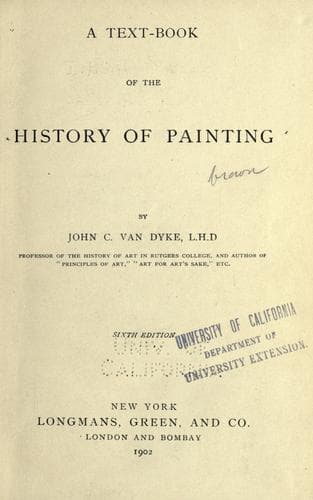
A Text-Book of the History of PaintingVan Dyke, John C.
History
A Text-Book of the History of Painting
Van Dyke, John C.
Painting -- History
Gal. Lon.; Moretto, altar-pieces Brera, Staedel
Mus., S. M. della Pieta Venice, Vienna, Berlin, Louvre,
Pitti, Nat. Gal. Lon.; Moroni, portraits Bergamo Gal.,
Uffizi, Nat. Gal. Lon., Berlin, Dresden, Madrid; Girolamo
dai Libri, Madonna Berlin, Conception S. Paolo Verona,
Virgin Verona Gal., S. Giorgio Maggiore Verona, Nat. Gal.
Lon.; Torbido, frescos Duomo, altar-pieces S. Zeno and S.
Eufemia Verona; Cavazzola, altar-pieces, Verona Gal. and
Nat. Gal. Lon.
CHAPTER XI.
ITALIAN PAINTING.
THE DECADENCE AND MODERN WORK. 1600-1894.
BOOKS RECOMMENDED: As before, also General Bibliography,
(page xv.); Calvi, _Notizie della vita e delle opere di Gio.
Francesco Barbiera_; Malvasia, _Felsina Pittrice_; Sir
Joshua Reynolds, _Discourses_; Symonds, _Renaissance in
Italy--The Catholic Reaction_; Willard, _Modern Italian
Art_.
THE DECLINE: An art movement in history seems like a wave that rises
to a height, then breaks, falls, and parts of it are caught up from
beneath to help form the strength of a new advance. In Italy
Christianity was the propelling force of the wave. In the Early
Renaissance, the antique, and the study of nature came in as
additions. At Venice in the High Renaissance the art-for-art's-sake
motive made the crest of light and color. The highest point was
reached then, and there was nothing that could follow but the breaking
and the scattering of the wave. This took place in Central Italy after
1540, in Venice after 1590.
Art had typified in form, thought, and expression everything of which
the Italian race was capable. It had perfected all the graces and
elegancies of line and color, and adorned them with a superlative
splendor. There was nothing more to do. The idea was completed, the
motive power had served its purpose, and that store of race-impulse
which seems necessary to the making of every great art was exhausted.
For the men that came after Michael Angelo and Tintoretto there was
nothing. All that they could do was to repeat what others had said, or
to recombine the old thoughts and forms. This led inevitably to
imitation, over-refinement of style, and conscious study of beauty,
resulting in mannerism and affectation. Such qualities marked the art
of those painters who came in the latter part of the sixteenth century
and the first of the seventeenth. They were unfortunate men in the
time of their birth. No painter could have been great in the
seventeenth century of Italy. Art lay prone upon its face under Jesuit
rule, and the late men were left upon the barren sands by the receding
wave of the Renaissance.
[Illustration: FIG. 52.--BRONZINO. CHRIST IN LIMBO. UFFIZI.]
Public-domain text, read in full here on John Shaqi.
Reviews
Reviews
No reviews yet
Be the first to share your thoughts on this work.
Elsewhere in the archive
Join the Discussion
Join the discussion
Sign in to leave a comment or review.
Sign InorCreate an account