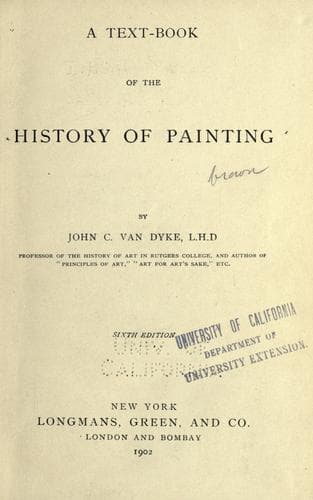
A Text-Book of the History of PaintingVan Dyke, John C.
History
A Text-Book of the History of Painting
Van Dyke, John C.
Painting -- History
ART MOTIVES AND SUBJECTS: As before, the chief subject of the art of
the Decadence was religion, with many heads and busts of the Madonna,
though nature and the classic still played their parts. After the
Reformation at the North the Church in Italy started the
Counter-Reformation. One of the chief means employed by this Catholic
reaction was the embellishment of church worship, and painting on a
large scale, on panel rather than in fresco, was demanded for
decorative purposes. But the religious motive had passed out, though
its subject was retained, and the pictorial motive had reached its
climax at Venice. The faith of the one and the taste and skill of the
other were not attainable by the late men, and, while consciously
striving to achieve them, they fell into exaggerated sentiment and
technical weakness. It seems perfectly apparent in their works that
they had nothing of their own to say, and that they were trying to say
over again what Michael Angelo, Correggio, and Titian had said before
them much better. There were earnest men and good painters among them,
but they could produce only the empty form of art. The spirit had
fled.
THE MANNERISTS: Immediately after the High Renaissance leaders of
Florence and Rome came the imitators and exaggerators of their styles.
They produced large, crowded compositions, with a hasty facility of
the brush and striking effects of light. Seeking the grand they
overshot the temperate. Their elegance was affected, their sentiment
forced, their brilliancy superficial glitter. When they thought to be
ideal they lost themselves in incomprehensible allegories; when they
thought to be real they grew prosaic in detail. These men are known in
art history as the Mannerists, and the men whose works they imitated
were chiefly Raphael, Michael Angelo, and Correggio. There were many
of them, and some of them have already been spoken of as the followers
of Michael Angelo.
Public-domain text, read in full here on John Shaqi.
Reviews
Reviews
No reviews yet
Be the first to share your thoughts on this work.
Elsewhere in the archive
Join the Discussion
Join the discussion
Sign in to leave a comment or review.
Sign InorCreate an account