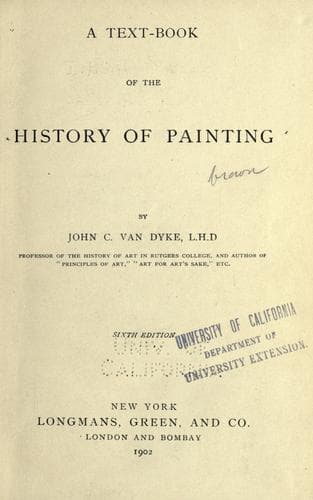
A Text-Book of the History of PaintingVan Dyke, John C.
History
A Text-Book of the History of Painting
Van Dyke, John C.
Painting -- History
SEVENTEENTH-CENTURY PAINTING: This was a century of great development
and production in France, the time of the founding of the French
Academy of Painting and Sculpture, and the formation of many picture
collections. In the first part of the century the Flemish and native
tendencies existed, but they were overawed, outnumbered by the
Italian. Not even Rubens's painting for Marie de' Medici, in the
palace of the Luxembourg, could stem the tide of Italy. The French
painters flocked to Rome to study the art of their great predecessors
and were led astray by the flashy elegance of the late Italians. Among
the earliest of this century was Freminet (1567-1619). He was first
taught by his father and Jean Cousin, but afterward spent fifteen
years in Italy studying Parmigianino and Michael Angelo. His work had
something of the Mannerist style about it and was overwrought and
exaggerated. In shadows he seemed to have borrowed from Caravaggio.
Vouet (1590-1649) was a student in Italy of Veronese's painting and
afterward of Guido Reni and Caravaggio. He was a mediocre artist, but
had a great vogue in France and left many celebrated pupils.
By all odds the best painter of this time was Nicolas Poussin
(1593-1665). He lived almost all of his life in Italy, and might be
put down as an Italian of the Decadence. He was well versed in
classical archaeology, and had much of the classic taste and feeling
prevalent at that time in the Roman school of Giulio Romano. His work
showed great intelligence and had an elevated grandiloquent style
about it that was impressive. It reflected nothing French, and had
little more root in present human sympathy than any of the other
painting of the time, but it was better done. The drawing was correct
if severe, the composition agreeable if formal, the coloring
variegated if violent. Many of his pictures have now changed for the
worse in coloring owing to the dissipation of surface pigments. He was
the founder of the classic and academic in French art, and in
influence was the most important man of the century. He was especially
strong in the heroic landscape, and in this branch helped form the
style of his brother-in-law, Gaspard (Dughet) Poussin (1613-1675).
Public-domain text, read in full here on John Shaqi.
Reviews
Reviews
No reviews yet
Be the first to share your thoughts on this work.
Elsewhere in the archive
Join the Discussion
Join the discussion
Sign in to leave a comment or review.
Sign InorCreate an account