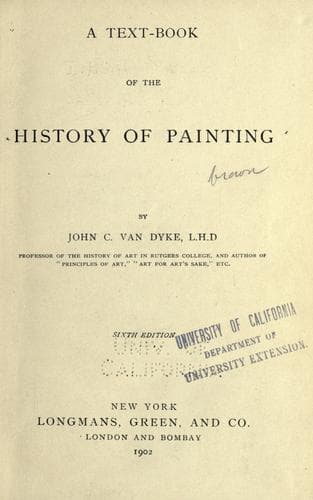
A Text-Book of the History of PaintingVan Dyke, John C.
History
A Text-Book of the History of Painting
Van Dyke, John C.
Painting -- History
The landscape painter of the period, however, was Claude Lorrain
(1600-1682). He differed from Poussin in making his pictures depend
more strictly upon landscape than upon figures. With both painters,
the trees, mountains, valleys, buildings, figures, were of the grand
classic variety. Hills and plains, sylvan groves, flowing streams,
peopled harbors, Ionic and Corinthian temples, Roman aqueducts,
mythological groups, were the materials used, and the object of their
use was to show the ideal dwelling-place of man--the former Garden of
the Gods. Panoramic and slightly theatrical at times, Claude's work
was not without its poetic side, shrewd knowledge, and skilful
execution. He was a leader in landscape, the man who first painted
real golden sunlight and shed its light upon earth. There is a soft
summer's-day drowsiness, a golden haze of atmosphere, a feeling of
composure and restfulness about his pictures that are attractive. Like
Poussin he depended much upon long sweeping lines in composition, and
upon effects of linear perspective.
[Illustration: FIG. 58--WATTEAU. GILLES. LOUVRE.]
COURT PAINTING: When Louis XIV. came to the throne painting took on a
decided character, but it was hardly national or race character. The
popular idea, if the people had an idea, did not obtain. There was no
motive springing from the French except an inclination to follow
Italy; and in Italy all the great art-motives were dead. In method
the French painters followed the late Italians, and imitated an
imitation; in matter they bowed to the dictates of the court and
reflected the king's mock-heroic spirit. Echoing the fashion of the
day, painting became pompous, theatrical, grandiloquent--a mass of
vapid vanity utterly lacking in sincerity and truth. Lebrun
(1619-1690), painter in ordinary to the king, directed substantially
all the painting of the reign. He aimed at pleasing royalty with
flattering allusions to Caesarism and extravagant personifications of
the king as a classic conqueror. His art had neither truth, nor
genius, nor great skill, and so sought to startle by subject or size.
Enormous canvases of Alexander's triumphs, in allusion to those of the
great Louis, were turned out to order, and Versailles to this day is
tapestried with battle-pieces in which Louis is always victor.
Considering the amount of work done, Lebrun showed great fecundity and
industry, but none of it has much more than a mechanical ingenuity
about it. It was rather original in composition, but poor in drawing,
lighting, and coloring; and its example upon the painters of the time
was pernicious.
Public-domain text, read in full here on John Shaqi.
Reviews
Reviews
No reviews yet
Be the first to share your thoughts on this work.
Elsewhere in the archive
Join the Discussion
Join the discussion
Sign in to leave a comment or review.
Sign InorCreate an account