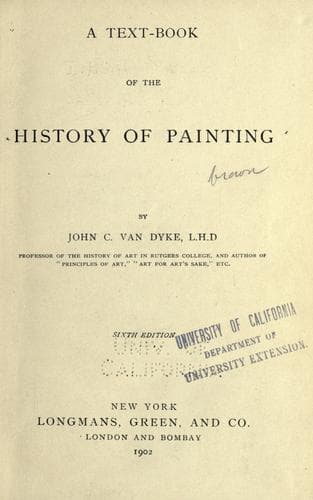
A Text-Book of the History of PaintingVan Dyke, John C.
History
A Text-Book of the History of Painting
Van Dyke, John C.
Painting -- History
Yet, in spite of the lack of moral and intellectual elevation, in
spite of frivolity and make-believe, this art was infinitely better
than the pompous imitation of foreign example set up by Louis XIV. It
was more spontaneous, more original, more French. The influence of
Italy began to fail, and the painters began to mirror French life. It
was largely court life, lively, vivacious, licentious, but in that
very respect characteristic of the time. Moreover, there was another
quality about it that showed French taste at its best--the decorative
quality. It can hardly be supposed that the fairy creations of the age
were intended to represent actual nature. They were designed to
ornament hall and boudoir, and in pure decorative delicacy of design,
lightness of touch, color charm, they have never been excelled. The
serious spirit was lacking, but the gayety of line and color was well
given.
[Illustration: FIG. 59.--BOUCHER. PASTORAL. LOUVRE.]
Watteau (1684-1721) was the one chiefly responsible for the coquette
and soubrette of French art, and Watteau was, practically speaking,
the first French painter. His subjects were trifling bits of
fashionable love-making, scenes from the opera, fetes, balls, and the
like. All his characters played at life in parks and groves that never
grew, and most of his color was beautifully unreal; but for all that
the work was original, decorative, and charming. Moreover, Watteau was
a brushman, and introduced not only a new spirit and new subject into
art, but a new method. The epic treatment of the Italians was laid
aside in favor of a genre treatment, and instead of line and flat
surface Watteau introduced color and cleverly laid pigment. He was a
brilliant painter; not a great man in thought or imagination, but one
of fancy, delicacy, and skill. Unfortunately he set a bad example by
his gay subjects, and those who came after him carried his gayety and
lightness of spirit into exaggeration. Watteau's best pupils were
Lancret (1690-1743) and Pater (1695-1736), who painted in his style
with fair results.
After these men came Van Loo (1705-1765) and Boucher (1703-1770), who
turned Watteau's charming fetes, showing the costumes and manners of
the Regency, into flippant extravagance. Not only was the moral tone
and intellectual stamina of their art far below that of Watteau, but
their workmanship grew defective. Both men possessed a remarkable
facility of the hand and a keen decorative color-sense; but after a
time both became stereotyped and mannered. Drawing and modelling were
neglected, light was wholly conventional, and landscape turned into a
piece of embroidered background with a Dresden china-tapestry effect
about it. As decoration the general effect was often excellent, as a
serious expression of life it was very weak, as an intellectual or
moral force it was worse than worthless. Fragonard (1732-1806)
followed in a similar style, but was a more knowing man, clever in
color, and a much freer and better brushman.
Public-domain text, read in full here on John Shaqi.
Reviews
Reviews
No reviews yet
Be the first to share your thoughts on this work.
Elsewhere in the archive
Join the Discussion
Join the discussion
Sign in to leave a comment or review.
Sign InorCreate an account