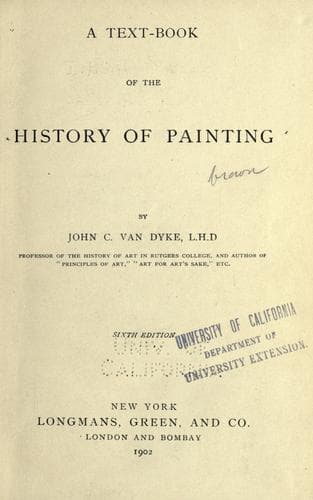
A Text-Book of the History of PaintingVan Dyke, John C.
History
A Text-Book of the History of Painting
Van Dyke, John C.
Painting -- History
His contemporary, Le Sueur (1616-1655), was a more sympathetic and
sincere painter, if not a much better technician. Both were pupils of
Vouet, but Le Sueur's art was religious in subject, while Lebrun's was
military and monarchical. Le Sueur had a feeling for his theme, but
was a weak painter, inclined to the sentimental, thin in coloring, and
not at all certain in his drawing. French allusions to him as "the
French Raphael" show more national complacency than correctness.
Sebastian Bourdon (1616-1671) was another painter of history, but a
little out of the Lebrun circle. He was not, however, free from the
influence of Italy, where he spent three years studying color more
than drawing. This shows in his works, most of which are lacking in
form.
Contemporary with these men was a group of portrait-painters who
gained celebrity perhaps as much by their subjects as by their own
powers. They were facile flatterers given over to the pomps of the
reign and mirroring all its absurdities of fashion. Their work has a
graceful, smooth appearance, and, for its time, it was undoubtedly
excellent portraiture. Even to this day it has qualities of drawing
and coloring to commend it, and at times one meets with exceptionally
good work. The leaders among these portrait-painters were Philip de
Champaigne (1602-1674), the best of his time; Pierre Mignard
(1610?-1695), a pupil of Vouet, who studied in Rome and afterward
returned to France to become the successful rival of Lebrun;
Largilliere (1656-1746) and Rigaud (1659-1743).
EIGHTEENTH-CENTURY PAINTING: The painting of Louis XIV.'s time was
continued into the eighteenth century for some fifteen years or more
with little change. With the advent of Louis XV. art took upon itself
another character, and one that reflected perfectly the moral, social,
and political France of the eighteenth century. The first Louis
clamored for glory, the second Louis revelled in gayety, frivolity,
and sensuality. This was the difference between both monarchs and both
arts. The gay and the coquettish in painting had already been
introduced by the Regent, himself a dilettante in art, and when Louis
XV. came to the throne it passed from the gay to the insipid, the
flippant, even the erotic. Shepherds and shepherdesses dressed in
court silks and satins with cottony sheep beside them posed in
stage-set Arcadias, pretty gods and goddesses reclined indolently upon
gossamer clouds, and court gallants lounged under artificial trees by
artificial ponds making love to pretty soubrettes from the theatre.
Public-domain text, read in full here on John Shaqi.
Reviews
Reviews
No reviews yet
Be the first to share your thoughts on this work.
Elsewhere in the archive
Join the Discussion
Join the discussion
Sign in to leave a comment or review.
Sign InorCreate an account