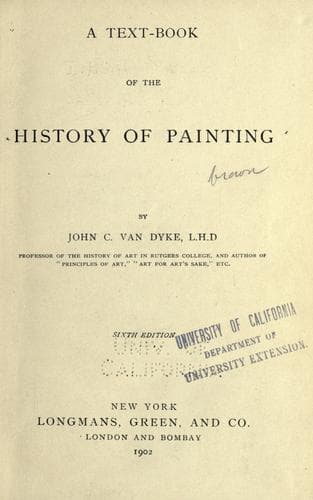
A Text-Book of the History of PaintingVan Dyke, John C.
History
A Text-Book of the History of Painting
Van Dyke, John C.
Painting -- History
Religion as an art-motive, or even as an art-subject, ceased to obtain
anywhere. The Church failed as an art-patron, and the walls of
cloister and cathedral furnished no new Bible readings to the
unlettered. Painting, from being a necessity of life, passed into a
luxury, and the king, the state, or the private collector became the
patron. Nature and actual life were about the only sources left from
which original art could draw its materials. These have been freely
used, but not so much in a national as in an individual manner. The
tendency to-day is not to put forth a universal conception but an
individual belief. Individualism--the same quality that appeared so
strongly in Michael Angelo's art--has become a keynote in modern work.
It is not the only kind of art that has been shown in this century,
nor is nature the only theme from which art has been derived. We must
remember and consider the influence of the past upon modern men, and
the attempts to restore the classic beauty of the Greek, Roman, and
Italian, which practically ruled French painting in the first part of
this century.
FRENCH CLASSICISM OF DAVID: This was a revival of Greek form in art,
founded on the belief expressed by Winckelmann, that beauty lay in
form, and was best shown by the ancient Greeks. It was the objective
view of art which saw beauty in the external and tolerated no
individuality in the artist except that which was shown in technical
skill. It was little more than an imitation of the Greek and Roman
marbles as types, with insistence upon perfect form, correct drawing,
and balanced composition. In theme and spirit it was pseudo-heroic,
the incidents of Greek and Roman history forming the chief subjects,
and in method it rather despised color, light-and-shade, and natural
surroundings. It was elevated, lofty, ideal in aspiration, but coldly
unsympathetic because lacking in contemporary interest; and, though
correct enough in classic form, was lacking in the classic spirit.
Like all reanimated art, it was derivative as regards its forms and
lacking in spontaneity. The reason for the existence of Greek art died
with its civilization, and those, like the French classicists, who
sought to revive it, brought a copy of the past into the present,
expecting the world to accept it.
Public-domain text, read in full here on John Shaqi.
Reviews
Reviews
No reviews yet
Be the first to share your thoughts on this work.
Elsewhere in the archive
Join the Discussion
Join the discussion
Sign in to leave a comment or review.
Sign InorCreate an account