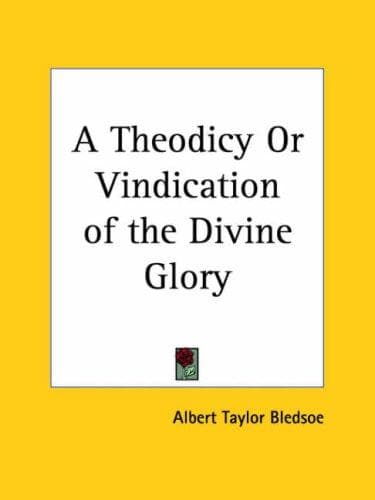
A Theodicy, or, Vindication of the Divine GloryBledsoe, Albert Taylor
Religion
A Theodicy, or, Vindication of the Divine Glory
Bledsoe, Albert Taylor
Theodicy
But though the reformers were thus, in some respects, more true to their
fundamental principle than their followers have been, we are not to
suppose that they are free from all inconsistencies and
self-contradiction. Thus, if “foreknowledge is a thunderbolt” to dash the
doctrine of free-will into atoms, it destroyed free-will in man before the
fall as well as after. Hence the thunderbolt of Luther falls upon his own
doctrine, that man possessed free-will in his primitive state, with as
much force as it can upon the doctrine of his opponents. He is evidently
caught in the toils he so confidently prepared for his adversary. And how
many of the followers of the great reformer adopt his doctrine, and wield
his thunderbolts, without perceiving how destructively they recoil on
themselves! Though they ascribe free-will to man as one of the elements of
his pristine glory, yet they employ against it in his present condition
arguments which, if good for anything, would despoil, not only man, but
the whole universe of created intelligences—nay, the great Uncreated
Intelligence himself—of every vestige and shadow of such a power.
It is a wonderful inconsistency in Luther, that he should so often and so
dogmatically assert that the doctrine of free-will falls prostrate before
the prescience of God, and at the same time maintain the freedom of the
divine will. If foreknowledge is incompatible with the existence of
free-will, it is clear that the will of God is not free; since it is on
all sides conceded that all his volitions are perfectly foreseen by him.
Yet in the face of this conclusion, which so clearly and so irresistibly
follows from Luther’s position, he asserts the freedom of the divine will,
as if he were perfectly unconscious of the self-contradiction in which he
is involved. “It now then follows,” says he, “that free-will is plainly a
divine term, and can be applicable to none but the Divine Majesty
only.”(8) ... He even says, If free-will “be ascribed unto men, it is not
more properly ascribed, than the divinity of God himself would be ascribed
unto them; which would be the greatest of all sacrilege. Wherefore, it
becomes theologians to refrain from the use of this term altogether,
whenever they wish to speak of human ability, and to leave it to be
applied to God only.”(9) And we may add, if they would apply it to God, it
becomes them to refrain from all such arguments as would show even such an
application of it to be absurd.
Public-domain text, read in full here on John Shaqi.
Reviews
Reviews
No reviews yet
Be the first to share your thoughts on this work.
Join the Discussion
Join the discussion
Sign in to leave a comment or review.
Sign InorCreate an account