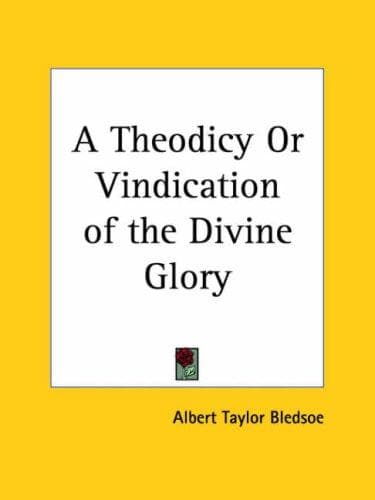
A Theodicy, or, Vindication of the Divine Glory — John Shaqi
A Theodicy, or, Vindication of the Divine GloryBledsoe, Albert Taylor
Religion
A Theodicy, or, Vindication of the Divine Glory
Bledsoe, Albert Taylor
Theodicy
He answers these questions precisely as they were answered by Luther and
Calvin more than a hundred years before his time. In order to solve this
great difficulty, and establish an agreement between necessity and
liberty, he insists on the distinction between co-action and necessity.
Sir James Mackintosh says, that “in his treatise _de Servo Arbitrio_
against Erasmus, Luther states the distinction between co-action and
necessity as familiar a hundred and fifty years before it was proposed by
Hobbes, or condemned in the Jansenists.”(10) According to his definition
of liberty, it is merely a freedom from co-action, or external compulsion.
“I conceive liberty,” says he, “to be rightly defined in this manner:
Liberty is the absence of all the impediments to action that are not
contained in the nature and intrinsical qualities of the agent: as for
example, the water is said to descend freely, or to have liberty to
descend by the channel of the river, because there is no impediment that
way; but not across, because the banks are impediments; and though the
water cannot ascend, yet men never say it wants liberty to ascend, but the
faculty or power, because the impediment is in the nature of the water and
intrinsical.” According to this definition, though a man’s volitions were
thrown out, not by himself, but by some irresistible power working within
his mind, say the power of the Almighty, yet he would be free, provided
there were no impediments to prevent the external effects of his
volitions. This is the liberty which water, impelled by the power of
gravity, possesses in descending the channel of a river. It is the liberty
of the winds and waves of the sea, which, by a sort of metaphor, is
supposed to reign over the dominions of a mechanical and materialistic
fate. It is the most idle of all idle things to speak of such a liberty,
_or rather, to use the word in such a sense_, when the controversy relates
to the freedom of the mind itself. What has such a thing to do with the
origin of human volitions, or the nature of moral agency? Is there no
difference between the motion of the body and the action of mind? Or is
there nothing in the universe of God but mere body and local motion? If
there is not, then, indeed, we neither have nor can conceive any higher
liberty than that which the philosopher is pleased to allow us to possess;
but if there be mind, then there may be things in heaven and earth which
are not dreamed of in his philosophy.
Public-domain text, read in full here on John Shaqi.
Reviews
Reviews
No reviews yet
Be the first to share your thoughts on this work.
Join the Discussion
Join the discussion
Sign in to leave a comment or review.
Sign InorCreate an account