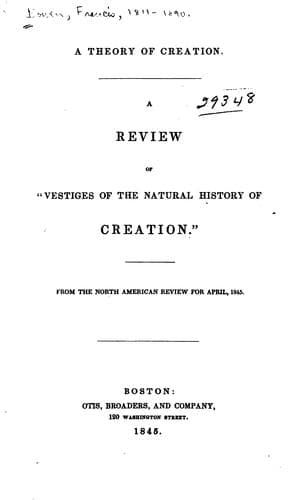
A Theory of Creation: A Review of 'Vestiges of the Natural History of Creation'Bowen, Francis
Religion
A Theory of Creation: A Review of 'Vestiges of the Natural History of Creation'
Bowen, Francis
Chambers, Robert, 1802-1871. Vestiges of the natural history of creation; Creation; Evolution (Biology)
Produced by Bryan Ness, Greg Bergquist and the Online
Distributed Proofreading Team at http://www.pgdp.net (This
book was produced from scanned images of public domain
material from the Google Print project.)
A THEORY OF CREATION.
A
REVIEW
OF
"VESTIGES OF THE NATURAL HISTORY OF
CREATION."
FROM THE NORTH AMERICAN REVIEW FOR APRIL, 1845.
BOSTON:
OTIS, BROADERS, AND COMPANY,
120 WASHINGTON STREET.
1845.
CAMBRIDGE:
METCALF AND COMPANY,
PRINTERS TO THE UNIVERSITY.
A
THEORY OF CREATION.
_Vestiges of the Natural History of Creation._ New York: Wiley &
Putnam. 1845. 12mo. pp. 291.
This is one of the most striking and ingenious scientific romances that
we have ever read. The writer of it is a bold man; he has undertaken to
give a hypothetical history of creation, beginning, as the title-pages
say, at the earliest period, and coming down to the present day. It is
not quite so authentic as that of Moses, nor is it written with such an
air of simplicity and confidence as the narrative of the Jewish
historian; but it is much longer, and goes into a far greater variety of
interesting particulars. It contradicts the Jewish cosmogony in a few
particulars, and is at variance with probability and the ordinary laws
of human reasoning in many others. But the rather liberal rules of
interpretation, which it is now the fashion to apply to the first
chapter of Genesis, will relieve the reader from any scruples on the
former account; and as to the latter, in these days of scientific
quackery, it would be quite too harsh to make any great complaint about
such peccadilloes. The writer has taken up almost every questionable
fact and startling hypothesis, that have been promulgated by proficients
or pretenders in science during the present century, except animal
magnetism; and for this omission we have reason to be thankful. The
nebular hypothesis, Laplace's or Compte's theory of planets _shelled
off_ from the sun, spontaneous generation,--some of these vagaries, we
admit, are of much older date than the year 1800,--the Macleay system,
dogs playing dominoes, negroes born of white parents, materialism,
phrenology,--he adopts them all, and makes them play an important part
in his own magnificent theory, to the exclusion, in a great degree, of
the well-accredited facts and established doctrines of science.
Public-domain text, read in full here on John Shaqi.
Reviews
Reviews
No reviews yet
Be the first to share your thoughts on this work.
Join the Discussion
Join the discussion
Sign in to leave a comment or review.
Sign InorCreate an account