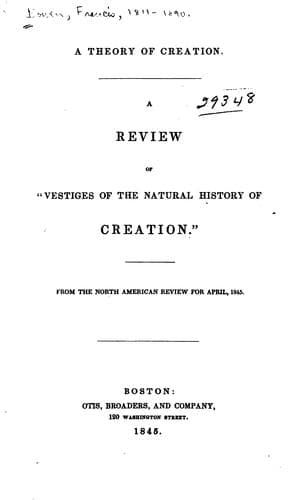
A Theory of Creation: A Review of 'Vestiges of the Natural History of Creation'Bowen, Francis
Religion
A Theory of Creation: A Review of 'Vestiges of the Natural History of Creation'
Bowen, Francis
Chambers, Robert, 1802-1871. Vestiges of the natural history of creation; Creation; Evolution (Biology)
Usually, it is true, each species produces only its like,--"every
creeping thing and beast of the earth" bringing forth young "_after his
kind_." But the development of a single animal, under the ordinary law,
takes place in a few weeks or days; while the development of distinct
races and species is the work of a whole creation, and is spread over
countless ages. It is reasonable to suppose, that the latter is effected
by means of a higher law, manifesting itself only at long intervals. Its
infrequent manifestation is no argument against the regularity and
necessity of its occurrence,--against its being a law at all. The comet
that visits our system only once in five hundred years is controlled by
the same inflexible principle which causes the return of another comet
once in five years. The conditions requisite for a development more
perfect than usual,--that is, for the production of a new
species,--instead of a new individual of the same species, may be
fulfilled only at long intervals; but when they are fulfilled, the
result--the more perfect development--takes place as necessarily, as
much by the virtue of law, as the more ordinary phenomenon of the
propagation of one race. These conditions may be answered in the
successive stages of improvement, through which the earth and its
atmosphere pass, during the vast periods of time contemplated in
geology. In the era of the old red sand-stone, for instance, there were
no higher animals than fishes, because the atmosphere was highly charged
with carbonic acid, and could not support respiration by lungs. When the
air became purer, the gills were changed into the imperfect lungs of the
amphibious tribes, such as the huge saurians and the frogs. Deprive
these latter animals, in their lower stage, of all access to the light,
and they will not advance to their higher stage. Put a tadpole into a
perforated box, and sink it to the bottom of a river, and the animal
will never be perfected into a frog; he will grow to an enormous size,
but he will continue a tadpole.
Public-domain text, read in full here on John Shaqi.
Reviews
Reviews
No reviews yet
Be the first to share your thoughts on this work.
Join the Discussion
Join the discussion
Sign in to leave a comment or review.
Sign InorCreate an account