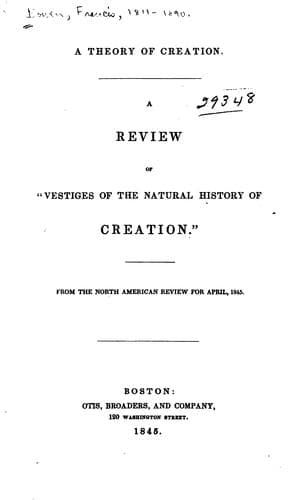
A Theory of Creation: A Review of 'Vestiges of the Natural History of Creation' — John Shaqi
A Theory of Creation: A Review of 'Vestiges of the Natural History of Creation'Bowen, Francis
Religion
A Theory of Creation: A Review of 'Vestiges of the Natural History of Creation'
Bowen, Francis
Chambers, Robert, 1802-1871. Vestiges of the natural history of creation; Creation; Evolution (Biology)
Now, all the instances adduced by our author, to show similarity of
action in the organic and the inorganic world, are irrelevant. The
analogies are not merely imperfect; they are no analogies at all.
Crystals increase by the aggregation of new particles on the external
surfaces of the parts already formed; there is no consentaneous
operation of the parts on the whole. The molecules of crystals are
homogeneous throughout, and the several aggregates of these molecules
are independent of each other; while organized bodies are composed of
parts perfectly dissimilar from each other, but all of which conspire to
one end. "The growth of organized bodies," says Mueller, "takes place in
all particles of their substance at the same time, while the increase of
the mass in inorganic bodies is produced by external apposition."
Frostwork on the windows may resemble vegetable _forms_; but it has no
resemblance whatever to vegetable _life_. Electricity may counterfeit
the _action of life_, for a moment, on a particular limb, by causing the
muscles to twitch; but it does not counterfeit _life itself_, by causing
all the parts again to contribute to the sustentation of the whole. A
French chemist, by electric action, may have produced _globules_ in
albumen; there is nothing very wonderful in that; any one may blow
bubbles in a viscid fluid. The resemblance between these globules and
proper germinal vesicles amounts to nothing more than similarity of
outward shape; there is no more real resemblance between them than
between the oval lump of chalk which farmers sometimes put into a hen's
nest, in order to deceive poor Dame Partlet, and the real egg which the
hen deposits by the side of it. Certainly, the imponderable agents,
heat, light, and electricity, are in some mysterious way _connected
with_ life, so as to contribute to its support; there is nothing more in
this assertion than in the familiar proposition, that a seed will
germinate only under the proper conditions of soil and climate; but
that these agents, acting on inorganic matter, ever _create_ or
_commence_ life is a pure hypothesis, not supported even by the shadow
of a fact.
Having thus shown how weak are the general considerations in favor of
the theory, that animated beings may be created out of inorganic matter
by mere natural laws, we should proceed to consider the direct evidence
adduced to prove that life has actually been produced in this way. Here
the whole question is opened respecting the alleged instances of
equivocal generation, and we have neither space nor ability to discuss
them at length. Those who are curious respecting the question may find a
brief summary of the evidence on both sides in a former number of this
Journal.[1] We can mention only a few facts and arguments, which show
the extreme improbability of the doctrine supported by our author and a
few other theorists.
Public-domain text, read in full here on John Shaqi.
Reviews
Reviews
No reviews yet
Be the first to share your thoughts on this work.
Join the Discussion
Join the discussion
Sign in to leave a comment or review.
Sign InorCreate an account