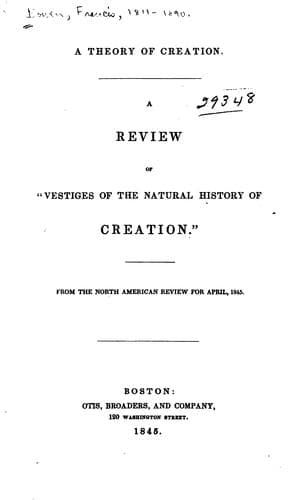
A Theory of Creation: A Review of 'Vestiges of the Natural History of Creation'Bowen, Francis
Religion
A Theory of Creation: A Review of 'Vestiges of the Natural History of Creation'
Bowen, Francis
Chambers, Robert, 1802-1871. Vestiges of the natural history of creation; Creation; Evolution (Biology)
These minute creatures are prolific to a degree that transcends all
calculation; and they exist, either in the egg or maturely developed, in
inconceivable numbers. A single wheel-animalcule, _Hydatina senta_,
which was watched for more than eighteen days, and which lives still
longer, is capable of a fourfold increase in twenty-four or thirty
hours; a rate of propagation which would afford in ten days a million of
beings. From their tenacity of life, extraordinary powers of
reproduction, and incalculable numbers, their united influence may be
said to be far more important, in all the great operations of nature,
than that of the larger and more perfectly developed organisms. They
swarm in all the seas, and play an important part in choking up harbours
and forming great deposits at the mouths of rivers. The remains of those
which have perished form great beds and strata in the crust of the
earth. The silicious stone, called Tripoli, is entirely composed of such
remains; at Bilin, in Bohemia, there is one stratum of this substance,
fourteen feet thick, one cubic inch of which is estimated to contain
forty-one thousand millions of individuals. Their extreme tenacity of
life is evinced by the fact, that many of them may be entirely
desiccated, and preserved in pure sand for several years, after which,
on the application of a drop of water, they may be restored to life. In
this dried state, M. Doyere exposed some of them to a heat equal to that
of boiling water, and afterwards revived them; though, in an active
state, if subjected to a much lower temperature, they perish. If, then,
the fully developed and mature can resist such powerful extraneous
causes of destruction, how much more must the ova possess the power of
enduring them without losing their latent life! The following extract
from Professor Owen's Lectures shows the bearing of these facts upon the
question of equivocal generation.
Public-domain text, read in full here on John Shaqi.
Reviews
Reviews
No reviews yet
Be the first to share your thoughts on this work.
Join the Discussion
Join the discussion
Sign in to leave a comment or review.
Sign InorCreate an account